


Blog by Ciarán Nugent, NERI economist on recruitment problems in hospitality being overblown.
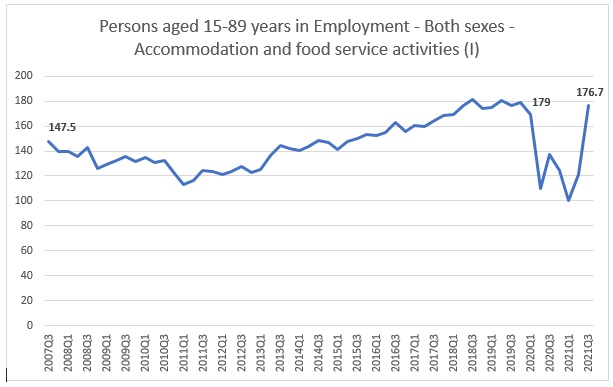
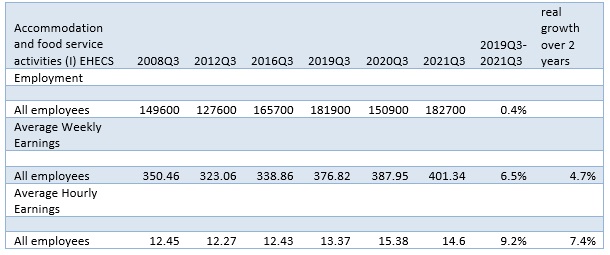
Between July and September 2021 (when hospitality was still under some restrictions) Labour Force Survey data have employment numbers in the sector as (all but) fully recovered relative to the same quarter in 2019 (around 176,000 or 1% down on 2019). EHECS, another survey has employment numbers in Accommodation and Food as slightly higher in summer 2021 relative to 2019. Employment in Hospitality in Summer 2021 was, give or take a few thousand, the highest number in the sector in Irish history. This is in spite of the fact of vaccines for entry, curtailed opening hours, lower international visitors etc. etc. A full 50,000 workers returned to the labour market that quarter. This is more than Irish employment (in its entirety across 13 sectors) has grown in any quarter in Irish history (pre-pandemic). It takes a couple of months for the data to be collected and published by the CSO. These are the most up-to-date numbers and we can guess that restrictions brought in in December, like every other lockdown, likely resulted in some employees dropping out of work again.
At that very same time in 2021 we were fed stories about recruitment problems in Hospitality, which hit headlines everywhere. One claim was that a kitchen porter job advertised for €30,000 could not be filled. Other employers claimed they had to start looking over seas for workers willing to work precarious and low wage contracts. As I wrote before, this was all framed (ridiculously) in relation to the level of Pandemic Unemployment Payment being too high. Based on headline employment figures, all the jobs lost in the pandemic were filled or replaced by new ones. Even terrible ones. During this whole period, vacancies on Jobbridge 2.0 at poverty wages are still being advertised, and it seems filled. There are plenty of people out there who could do with more money (any more) for rent.
Recent analysis from the Department of social protection (September 2021) showed that 58 percent of Hospitality workers on PUP returned to their employer, with a further 35 percent of the rest (14 percent) returning to a different employer in Hospitality (72 percent returned altogether). Many also went to other low wage sectors in Retail and Administration. Relatively few moved into higher end employment. The recruitment issues clearly did not come to fruition in any real way (unless of course there’s some argument that demand for hospitality workers and services in summer 2021 was way ahead of what it had been two years previous in a period where international travel was still massively curtailed, when older people still avoided public places and lockdown rules curtailed young people). This wouldn’t make much sense.
And of course, a lot of this is completely natural and would likely occur in regular times anyway. Accommodation and Food is notoriously temporary with high turnover. Students make up large swathes of the employment. Many of them would have finished their studies. Most even, considering we’ve had two graduation years since March 2020.
Evidence of any ‘great resignation’ is just not there either. Not yet anyway. Personally, I think musings of this nature are based on flawed perceptions of the labour market for younger workers. Who could afford this? If you’re under 25 jobseekers’ benefit is not much more than €100 a week. Who would voluntarily live like this? Very few. That’s why less than 5% of under 25’s on PUP at the peak are now on PUP.
So, why are we getting the same lines again in January 2022? Inflation.
This is likely an effort to get ahead of the wage claims that will come from higher costs of living this year. Inflation looks like it’s going to be around 5/6 percent. Inflation for low income groups and renters is likely to be even higher. The minimum wage increased by 3% in January. Minimum wage workers will therefore be able to buy less with their wages this year, pushing some further into poverty and deprivation. Somewhere in the region of 25/30 percent of all minimum wage workers in Ireland work in Hospitality. There will be pressure to increase, not just the minimum wage, but welfare payments (remember that PUP was to blame for non-existent recruitment issues in summer last year) to prevent more and more people slipping into material deprivation (this increased in 2019, 2020 and 2021 as a share of both households and workers). Some of this has already begun with extra government assistance with fuel costs at the end of 2021.
The replacement rate is the value of social welfare payments relative to income received in employment. The rate of jobseekers’ benefit is especially important for the low wage Hospitality sector. If unemployment support is high, Hospitality will have to offer higher wages to make work more attractive than unemployment for workers (not all workers). The basic jobseekers’ rate is €203 for over 25’s and €117 for under 25’s or about 19 and 10 hours at the minimum wage, respectively. An increase in minimum wage would likely come with any social welfare increases to avoid disincentivising work.
We’re now hearing that there’s a shortfall of 40,000 workers (which would represent a 22 percent increase on the numbers before lockdown). That demand for hospitality services has increased by 22 percent? In January? Less than two weeks after hospitality was finally (and surprisingly, last minute) fully reopened? While a lot of people are still being cautious?
Logistically, increasing employment by 20% in two weeks would be extremely difficult regardless of any concerns around wage/welfare mismatch.
This is strategic messaging to warn against any increases in incomes at the bottom which will put upward pressure on wages at the bottom of the distribution and impact the bottom line of employers in Hospitality. ‘We can’t fill 40,000 positions as it is with welfare rates as they are?’. ‘Employment will fall’. ‘Competitiveness!’.
A quick glance at indeed.ie shows that there are no advertisements for jobs in hotels more than two weeks old, out of around 450. Maybe we should wait a week or two.