


In this weeks blog by Ciarán Nugent NERI economist, he explores wages as we emerge from the pandemic.
As we emerge from lockdown and emergency income supports for workers made unemployed by the pandemic are withdrawn, the real unemployment rate will soon reveal itself. With budget time approaching the rhetorical attack on wages has already kicked off.
This week, watching the national broadcaster we were led to believe that the minimum rate to fill a position for a kitchen porter is €30,000. At the same time, I’m yet to see or hear from one person who faces cuts in income support and what it means to them or their family anywhere on Irish broadcast media (maybe someone can point me in the right direction). What we should be really worried about, we’re told, is ‘competitiveness’. Here we go again.
That an employer is not able to fill a position for a kitchen porter for €30,000 a year in Dublin with the upper bound unemployment estimate at 355,000 in August (it was approximately 190,000 in February 2020) beggars belief. This was repeated (with apparently no scrutiny) in several national news publications. There is some very important piece of the puzzle missing from this story. The term ‘pigs fly’ comes to mind. To use an analogy with physics, this would be like Isaac Newton’s apple flying off into deep space.
This ‘anecdote’ and the explanation of how this ‘came about’ was framed exclusively in terms of the relatively high pandemic unemployment payment (PUP), which is currently being wound down. First of all, if you have advertised a position for €30,000 on jobs.ie or indeed.ie, it’s not just the pandemic unemployment payment that you’re competing with. This discussion was conducted by several people who clearly don’t understand what €30,000 means to most people and almost half of all Irish workers. It would literally mean a pay rise to more than 1 million Irish workers (or 47% of the Irish workforce).
Assuming a 52 week year and a 39 hour week this comes to €14.79 an hour.
- Half of all full-time workers under 30 earn less than this figure.
- Half of all retail workers earn less
- Half of all Arts, entertainment and recreation workers earn less
- 1 in 10 Irish Professionals working full-time earn less than a similar figure (€15.11).
- More than half of full-time workers in Elementary occupations (of which kitchen porters are included) earn less than €12.82.
None of these workers are interested in a pay rise or a change of scenery even? No one on the PUP have mortgage payments or rent to pay in the coming months?
A poster outside any hotel in Dublin would have likely done the trick. Currently there are dozens of kitchen porter jobs on jobs.ie, none of which are more than 10 days old (other than a handful of rolling advertisements from recruitment agencies).
We have the 2nd highest share (1 in 5) of workers on low wages (2/3rds of the median) of any high-income EU country and an outlier in terms of the share of graduates in low pay in Europe (13 percent and twice the EU average).
So, it’s all about competitiveness, again.
In an Irish context, competitiveness is mostly confused with wage competitiveness.
In developed economies, minimum wages in the context of wage competitiveness are only relevant in low value added sectors (hospitality in Ireland).
There are two main reasons why we focus so much on the sector in Ireland: Irish domestic business is disproportionately focused in this low productivity, low value and low wage sector and wages set in the sector have an important role (on behalf of employers) in dampening wage growth across the economy (austerity). It is, by some margin, the lowest paid sector in Ireland out of 13. Over half of workers in the sector are on low wages and the entire sector only accounts for about 1.8 percent of Gross Value Added to the Irish economy and 1 in 12 employees (and by the way, the sector is especially reliant on traffic from two countries that I’m not sure we can rely on over the next few years; the US and the UK).
This development strategy is at odds with the aspirations of the majority of Irish people, highly educated younger generations especially. Few share this low wage and dystopian vision for the future of barely scraping by.
Contrary to the prevailing narrative the most successful traded sectors in Ireland (pharmaceuticals and ICT), which drove the recovery in the early years did not restrain wages. Austerity cutbacks and minimum wage freezes had nothing to do with our 26% GDP growth rate in 2015 (remember Leprechaun economics?). Low wage sectors, like hospitality, did not drive recovery and they certainly don’t drive living standards.
One striking feature of the top ten most ‘competitive’ economies in the world according to two prominent international indices is that they are exclusively high-wage economies:
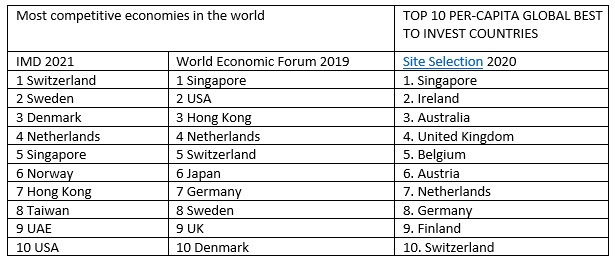
Site Selection link for chart above.
These competitiveness indices are aggregated using dozens of indicators from the effectiveness of institutions to innovation to third level education.
According to IMD, Ireland’s ranking rose from 24th position in 2011 to 7th in 2016, back to 13th in 2021 out of 64 countries.
We fall behind in:
- basic infrastructure (31st),
- technological infrastructure (19th),
- scientific infrastructure (20th),
- international investment (40th),
- employment (34th)
- our worst relative performance is in prices (46th).
- Our digital competitiveness rank is 20th in the world
- technological competitiveness (30th)
- capital for technology (45th)
- training and education (35th)
The World Economic Forum (of Davos fame) has Ireland at 24th.
We fall behind in:
- competitive infrastructure (40th)
- ICT Adoption (49th)
- Macroeconomic stability (34th)
- the Financial System (42nd)
Our labour market score (6th) is our ‘best’ result from the right wing perspective of the WEF; ‘Labor markets must therefore have the flexibility to shift workers from one economic activity to another rapidly and at low cost, and to allow for wage fluctuations without much social disruption’. Jair Bolsanaro was their keynote speaker in 2019 after all. From a worker’s perspective it might be our worst result!
(Here’s one of the questions: In your country, how would you characterise the hiring and firing of workers? [1 = heavily impeded by regulations; 7 = extremely flexible])
You can hardly find mention of wage levels on the IMD website and issues around wages in WEF are confined to wage flexibility rather than minimum wages. The top ten list of countries attracting FDI per capita (above) are also all high-wage economies.
The minimum wage has little impact on flows of foreign direct investment (though we are constantly led to believe it does). And yet the only tool in the toolbox again, is to attack working conditions and pay.
The Nevin Economic Research Institute was founded during the recession in response to the fact that the right wing commentariat in Ireland won the rhetorical battle over the causes and solutions to the financial crisis of 2008 and subsequent bank bailout. Solutions from a workers’ perspective were drowned out and along with them alternative, inclusive solutions to the whole mess. To qoute an ESRI report from 2012: ‘though high wage levels in Ireland have become a primary issue in the current environment, they were not a principal factor in leading to the current downturn.’ The recession was due to a failure of financial regulation and capital, a fact which was very skilfully and successfully obscured and replaced with a false narrative on high wages and wage competitiveness. This justified austerity and cutting public sector wages and services to pay off the debts of Irish banks. Successive governments including Fianna Fáil, the Greens, Fine Gael and Labour all bought into and drove this narrative. Young people paid the price.
The conversation on competitiveness should focus on one question:
Do we want our domestic economy to be based on precarious employment and low wages, which have to be subsidised by the state in the form of supplementary welfare allowances or HAP so workers don’t starve and can put a roof over their heads? Do we see ourselves as a real developed economy and do we want to work to that end?
As we’ve seen, real competitiveness takes investment. Investment in infrastructure, education and training, research and development and investment in services to bring down prices (housing, childcare, transport). This means having levels of taxation typical of a developed economy. Irish employers pay some of the lowest PRSI rates in Europe. Bringing this up to European norms would bring in over €6 billion (the Dept of Education’s budget was €8.9 billion last year). Also, everyone (except the Irish government it seems) is advising to borrow now to fund capital projects.
The living wage should also be introduced at as soon as possible. The figure for 2021/2022 has just been published. It’s €12.90 up from €12.30 last year or 4.9 percent. The minimum wage is currently at €10.20.
In the short term, introducing a living wage will support demand and economic growth- more money in the pockets of low wage earners, more spending. Remember, the economy grew in 2020 because we protected incomes and tanked in 2009 in large part, because we failed to. Even the European Commission now agree. In the longer term, we should also remember that a living wage (as it is estimated based on the cost of living) needn’t rise rapidly and can theoretically fall if we seriously address the cost of living crisis – if rent and childcare costs were brought under control for example.