

As the prospect of a no-deal Brexit looms, much attention has focused on how the UK economy will react to life outside the EU on the first of November. While there are likely to be some immediate impacts on day one arising from border delays and turbulence in the financial markets, it would be unwise to expect any sort of ‘big bang’ event. In reality the real economic impact of a no-deal Brexit will be felt in the long run. However, some of the impact is already with us and this is no more evident than in the value of Sterling.
The pound took a massive hit in the aftermath of the referendum result, falling by over 16% in just two weeks. Since then the currency has fluctuated as the prospects for an orderly Brexit have ebbed and flowed. As negotiations intensified and a deal was in prospect, the pound appeared to be gaining some upward momentum in the first half of 2018. This was quashed in the second half of the year by the political chaos that surrounded the numerous defeats of the Withdrawal Agreement in the House of Commons.
This year with a positive upswing with the value of the currency with Sterling reaching highs in late March and early April as the prospects of the UK securing an extension gathered pace. However, the slow collapse of Theresa May’s government and the appointment of Boris Johnson have introduced the most dramatic decline in Sterling since 2016.

Since the beginning of May, Sterling has lost just under 8% of its value. As the chart above shows, the effective exchange rate has fallen from a high of 80.3 to a low of 74, a level not seen since September 2016.
A currency depreciation has different impacts for different economic actors. For those reliant on exports it can be a boon, but this is usually at the expense of those in the import dependent sectors of the economy. Consumers feel the ill effect of a devalued currency when travelling abroad and eventually the impact will be felt at home too in the form of increased inflation.
In 2016, the drop in the value of Sterling sent the rate of inflation shooting up from 0.8% in June to 2.8% the following September. The rate of inflation did not fall below 2% until January of this year. While this was a substantial increase in inflation, it was actually slightly less than was predicted at the time.
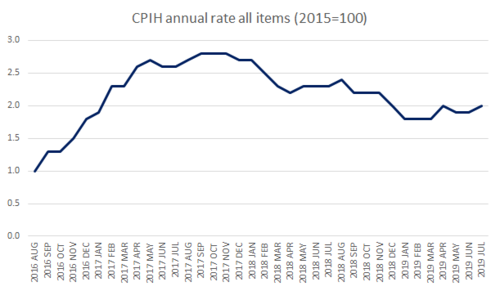
The Bank of England usually calculate that a 10% depreciation of Sterling translates into a 2.7 per cent increase in CPI inflation over 3 years, with half of the increase expected in the first year. The CPI did jump by 2% in the first year following the depreciation, but after that the effect seemed to peter out.
This shows the volatility of the pass through from currency fluctuations to inflation rates. The scales and speed of pass through can be very easily impacted by other market forces and global events. Calculating how Sterling’s recent depreciation will pass through to the inflation rate is further complicated by what assumptions are made about the final Brexit settlement.
At the beginning of this month the Bank of England forecast that inflation would actually fall back to 1.7% in the third quarter of this year before increasing gradually to 2.4% by 2022. The issue for the Bank of England is that their forecast assumes a smooth Brexit process and so they expect that Sterling would recover value after October 31. In this scenario, much of the recent depreciation would not pass through to the inflation rate as much of it would be too short-lived to have any impact on import prices.
All of the most recent depreciation in Sterling in attributed to the expectation of a no-deal Brexit. As such, if no-deal comes to pass, there may be a further slippage in the value of the pound, but much of the impact of a no-deal has already been priced in.
What all of this means is that inflation is forecast to increase whether or not a no deal Brexit occurs. If there is a deal, some of the currency effect will feed through, but much of the inflationary pass through can be averted.
However, if no-deal does come to pass, inflation is likely to be much higher. Even if there is no significant fall in Sterling’s value post October 31, the pass through from the depreciation up to now will still come to pass.