

In this blog, NERI economist Chris Smart summarises the main points from NERI Report no. 30 - 'Measuring "green" jobs in the Republic of Ireland' and NERI Report no. 31 - 'Characteristics of Worker's in Green Jobs'. The two Reports were written by Paul Goldrick-Kelly (NERI economist) and Niccolò De Vita and Seamus McCaul (NERI interns). Chris was involved in the writing of NERI Report no. 30.
As we face into the reality of tackling climate change we must come to grips with the reality that employment in Ireland as we know it will have to change. Exactly what that change will be depends very much on how we look at our labour market and whether we look at climate change as an obstacle or an opportunity.
There has been much talk of the growth of ‘green jobs’ and how our labour market will transition as we tackle the climate crisis. But what is a green job? This paper looks at different methodologies for categorising what are green jobs and applying these to Ireland.
There are two basic approaches to defining green jobs. The first is a top-down approach, looking at economic sectors and their production of either environmental goods and services for environmental protection or resource management, or by the emissions they generate per person employed.
If we look just at emissions per job by industry classification, certain industries such as Financial and Insurance Activities, Information and communication, Professional, scientific and technical activities, Human health and social work activities, and Education are relatively “green” compared to the rest of the economy.
On the other hand, Energy supply, agriculture, and transportation are particularly emissions intensive. This creates a stark regional disparity where the share of employment dedicated to such emissions intensive work will likely impact a large number of jobs.
Picking the top 5 polluting sectors and looking at the share of employment in each county in these sectors, we see that some counties (Cavan, Clare, Longford, Monaghan, Tipperary) have 30% or higher of their workers in emissions intensive sectors. This compares to 13% in Dublin or 17% in Wicklow.
Alternatively, there is the bottom-up approach which looks across the board at green occupations or the time spent on green tasks within the labour market. Even deciding on a definition of a green occupation can be contentious here, leading to several different classifications or approaches which produce very different quantifications of green jobs.
One approach which is often used to quantify jobs effected by greening which we deploy in the report breaks green jobs into 3 categories:
- those created by the “greening” of the economy (New and Emerging);
- those which are subject to changes in how they are carried out to meet the needs of a greener economy (Enhanced Skills);
- and those which do not necessarily need to change but are in increased demand as the economy becomes greener (Increased Demand).
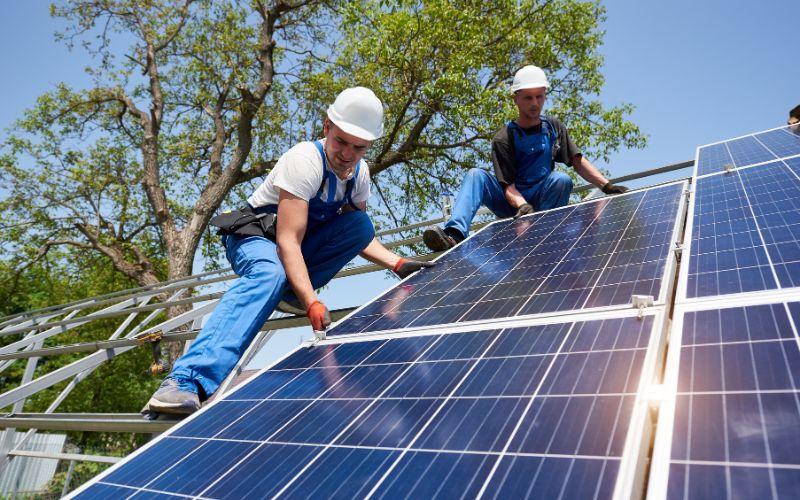
An example of New and Emerging green occupation could be a wind energy engineer or solar panel installer; an example of Enhanced Skills green occupation could be an operations manager in charge of bringing in greener practices, or a construction worker or farmer that has to adapt their working practices to reduce emissions; an example of Increased Demand occupation could be industrial production managers or those in welding trades that help to produce or maintain our new energy infrastructure.
A shorter, accompanying report looks at the differences in characteristics between those working in each of the 3 green jobs types. In New and Emerging green occupations, individuals were on average younger, more likely to have tertiary education, more likely to be in roles with a higher skill requirement, and more likely to be located in Dublin or the Greater Dublin Area.
Looking at Enhanced Skills green occupations, these workers were on average older, with lower levels of education and in roles with lower skills requirements, and typically located in more rural areas. These are roles that require change to adapt to the green transition; this also aligns to a degree with the areas where emissions intensive jobs are located as our top-down approach revealed. Ensuring that these individuals and regions that require enhanced skills are supported is important to avoid reinforcing those regional inequalities referenced above.
While each of these methodologies has their shortcomings, a picture does emerge of economic sectors and occupations that are located in particular regions that require enhanced skills or structural change to meet the needs of a green economy.
In the climate crisis, we need to focus not only on emissions intensive industries, but also look at the skills of workers within them. An ability to properly identify these individuals and assess the best way forward is crucial to understanding the challenges we face. Yes, certain regions will be affected more by this disruption because of their industrial makeup. However, this approach can help us identify green skills and employment which represent potential in those areas. Realising this potential is crucial if we are to realise a Just Transition.
From an Irish perspective, having a task-based approach to categorise the “greenness” of occupations that is relevant to our context would be useful. The ONS approach has its merits, but to pick a pertinent example, it takes farmers as a group and says they spend none of their time on green tasks. Excluding a group of people who do spend significant time limiting potential environmental damage from their work, and who are crucial for any Just Transition in terms of land use and I terms of adapting work practices, seems at odds with important work done by organisations such as the National Economic and Social Council to bring important groups such as farmers and others in the agriculture industry along with us. It would be helpful to invest the time and energy in making this task-based approach, as well as the occupational classifications, more specific to our context and more beneficial in terms of their usefulness for policy formation.
That being said, this is a live policy area, with recent joint work between the OECD and ILO still looking to define approaches to identifying these green jobs and sectors. Keeping abreast of developments in methods and applying these to an Irish context in a timely manner will ensure we can respond to challenges in the most effective way.