
Over a generation, Ireland has expanded third level education by more than almost any other EU country by vastly increasing the numbers of third level graduates from households with parents with lower levels of formal education.
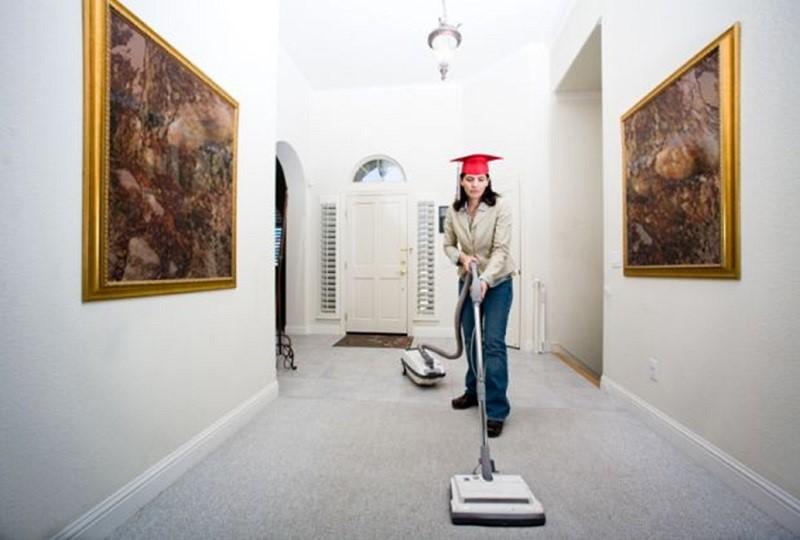
However, NERI economist Ciarán Nugent, summarising recent reports, finds that labour market opportunities in high end employment have not kept pace. Graduates, especially the sons and daughters of parents who did not go to third level, are increasingly working in jobs in which they are overqualified and are lower paid.
Over a generation, Ireland has expanded third level education by more than almost any other EU country by vastly increasing the numbers of third level graduates from households with parents with lower levels of formal education. However, labour market opportunities in high end employment have not kept pace and graduates, especially the sons and daughters of parents who did not go to third level, are increasingly working in jobs in which they are overqualified and are lower paid.
Following on from a report on overqualification of third level graduates in Ireland last year, the NERI (with the support of the Irish Research Council and the Department of Sociology in Maynooth University) publish a series of 3 themed reports this week on third level education and employment outcomes in 13 high-income EU countries with analysis of trends in the intergenerational transmission of third level attainment and the labour market outcomes of third level graduates by their social class background as part of a wider project.
1) Overqualification in high-income EU members
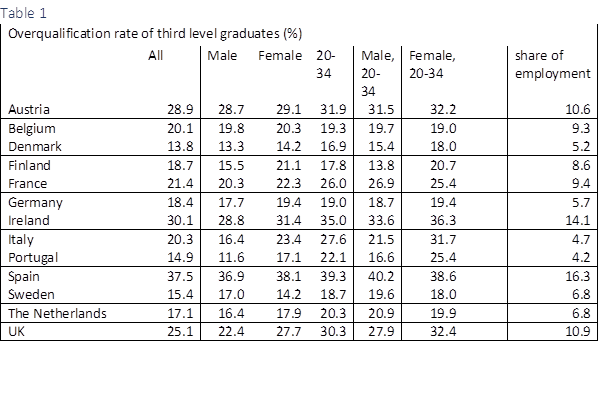
The findings suggest that the supply of third level graduates has outpaced the demand for graduates in the Irish labour market (among others) and that overqualified third level graduates in Ireland make up somewhere between 11% and 14% of all employment, the second highest share in the sample behind Spain. Approximately 30% of Irish third level graduates in employment work in occupations that do not require third level qualifications for entry. Most of these are in Clerical support or Service and Sales occupations). Almost 1 in 3 have tertiary qualifications in Business, Administration and Law.
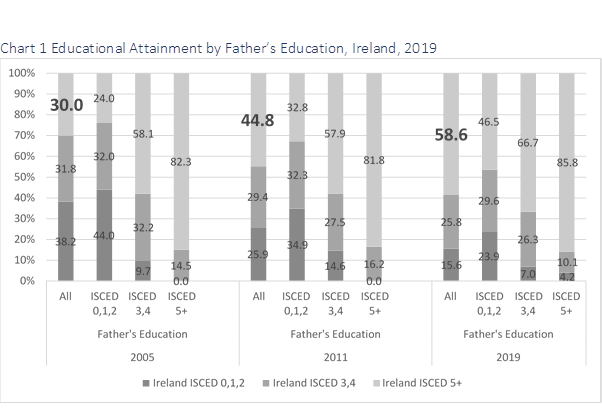
In broad terms, the reports show that from the 1990s, Ireland has transitioned from having one of the lowest shares of third level graduates to the highest in a high-income EU context. In that time, Ireland has narrowed the gap of third level attainment by social origin (in this case proxied by father’s education and by high vs low in a three-category breakdown of broad educational attainment) by more than any other country such that in 2019, Irish adults whose fathers were in the lowest bracket of formal education (in an Irish context this refers to formal education up to junior certificate) are now most likely out of 13 countries to have a third level qualification (46%, up from 24% in 2005). In every country, adults whose fathers were in the ISCED 0,1,2 (relatively low levels of formal educational attainment) and ISCED 3,4 (mid-range of formal educational attainment) categories were more likely to have attained some kind of third level qualification (ISCED 5-8) in 2019, than in 2005.
Education is the most important equaliser of opportunities and vehicle of social mobility and third level education allows access to occupations with high levels of social status and highest earnings. The data from 3 ad-hoc modules in the EU Survey on Income and Living Conditions in 2005, 2011 and 2019 show that at the same time most countries expanded third level education significantly (and in particular to adults from households with lower levels of formal education), trends in labour market outcomes of the third level graduate population were quite different from country to country as were the experiences of graduates by social origin (social mobility).
In a simple 3 category outcome variable to describe the experiences of third level graduates with 1) matched or high-end employment (Managerial/Professional/Technician roles) 2) overqualified worker or 3) inactive, the data show that out of 13 countries, the likelihood of graduates to be in high-end employment fell most in Ireland between 2005 and 2019 from 67% to 54.5% and is now the second lowest in the sample, behind Spain (51.8%). Sweden is the top performer with 79.1% of third level graduates in Managerial/Professional/Technician roles, followed by Portugal at 78.8%, Germany at 73.2% and the Netherlands at 73.0%.
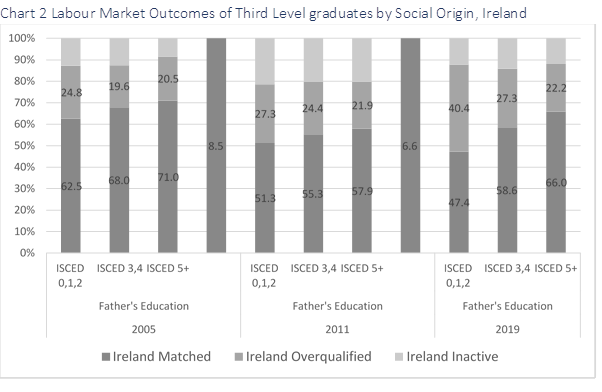
In all 13 countries between 2005 and 2019 the high-end employment gap between graduates with fathers in the highest and lowest brackets of formal education background widened. The high-end employment gap is widest in 2019 in Germany (77.4% vs 56.8% or 20.7 pp), Ireland (66.0% vs 47.4% or 18.6 pp) and Austria (70.7% vs 54.4% or 16.3 pp). In 2019, Irish graduates whose fathers were in the low formal education bracket were least likely to be in high-end employment in the sample (47.4%). Third level graduates in Ireland with father’s in the lowest education bracket saw the share in high-end employment fall by most between 2005 and 2019 too (from 62.5% or by 15.2 pp). The share working but overqualified increased by about the same amount from 25% in 2005 to 40% in 2019.