The NERI seminar titled 'The Pink-Collar Trap: Occupational Segregation and Gendered Vulnerability to AI' was presented by Ms. Thais Palanca, PhD Student, NOVA School of Business and Economics, Portugal. It took place on Wednesday 17 June, 2026 at 15:30 as an online Zoom event.
Please find the presentation.
Lecture Format:
Ms. Thais Palanca, PhD Student, NOVA School of Business and Economics, Portugal made her presentation for between 30-45 minutes. Subsequently, there was a Q&A section where the chairperson, Dr. Tom McDonnell, NERI presented questions from attendees to Thais.
Abstract:
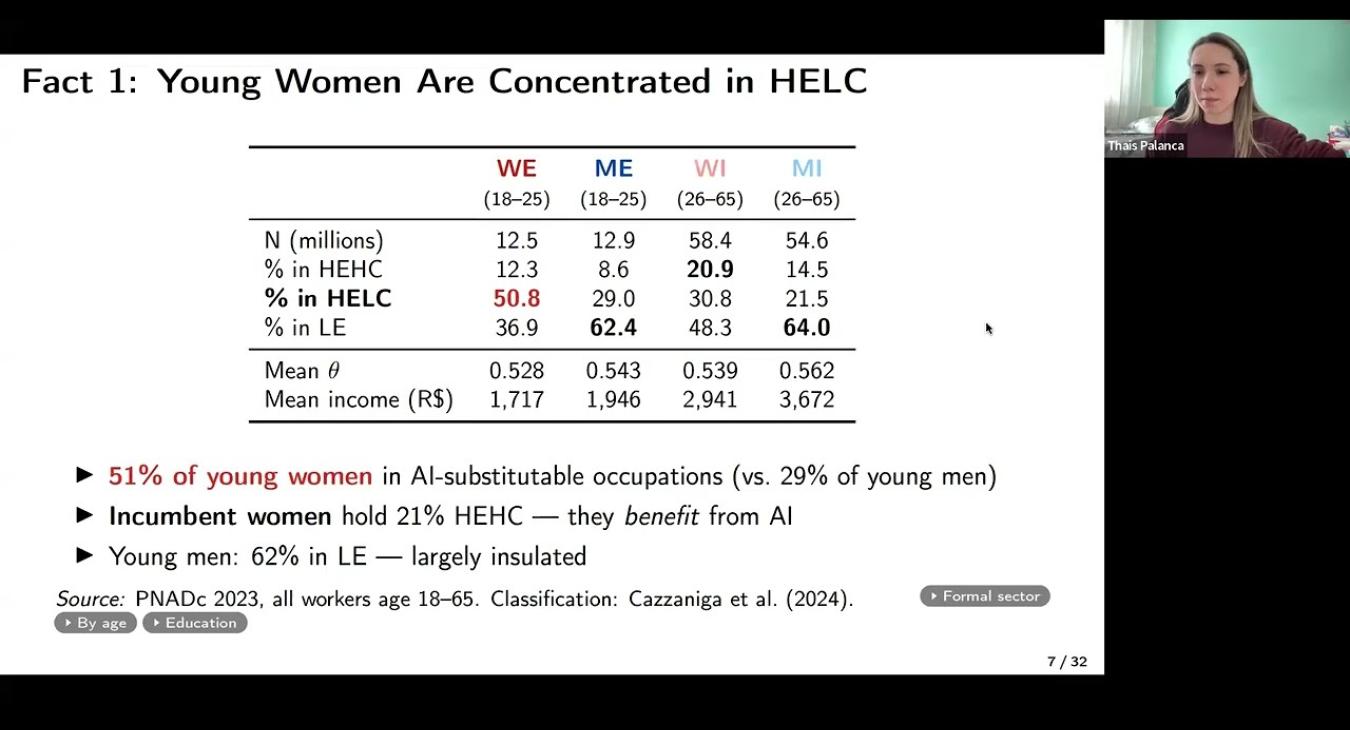
The occupations that brought women into the twentieth-century labor force (clerks, cashiers, receptionists, sales assistants) are now the most vulnerable to artificial intelligence. In Brazil, half of young women entering the labour market work in these AI-substitutable roles, compared to 29% of young men. A general equilibrium model with occupational sorting, switching costs, and educational barriers predicts that full AI adoption widens the within-cohort (entrants) gender earnings gap by 2.43 percentage points, driven overwhelmingly by wages (83%): young women absorb declining earnings in disrupted occupations while young men, concentrated in less-exposed sectors, are largely insulated. But here is the puzzle: the aggregate gender gap barely moves. The reason is that incumbent women, who hold professional positions where AI augments rather than replaces, benefit from the same technology that hurts entrants. This compositional masking effect means that any analysis pooling age groups will conclude, incorrectly, that AI is gender-neutral. It is not. Retraining 35% of non-degree women in vulnerable occupations eliminates the gap widening entirely.
Speakers details:
Thais Palanca is a PhD candidate in Economics at Nova School of Business and Economics. Her research focuses on labour economics, gender inequality, family formation, and the distributional consequences of structural economic change. Her current work examines how technological shocks interact with existing labour market and social structures, with particular attention to women’s economic outcomes. In this seminar, she presents research on how occupational segregation may shape gendered vulnerability to artificial intelligence.