  • X
  • Facebook
  • YouTube

Top header menu

  • Sign up to our mailing list
Home
  • Themes
      1. A New Economic Model
      2. Wages and Incomes
      3. Employment and Job Quality
      4. Climate and the Just Transition
      5. Taxes and the Welfare State
      6. Understanding the Labour Market
  • Our Work
      1. Research
      2. Blog
      3. The NERI videos series
      4. Learning about our economy
      5. Media
      6. Visualising our economy
  • Dashboards
      1. Broad sectors
      2. Subsectors
  • Events
      1. External event contributions
  • About
      1. Our team
      2. Our supporters
      3. Charities Governance Code
  • Contact

Topics

  • A New Economic Model
  • Wages and Incomes
  • Employment and Job Quality
  • Climate and the Just Transition
  • Taxes and the Welfare State
  • Understanding our Labour Market

Exploring Working Hours Disparities in Europe

Video
 February 
13,
 2025

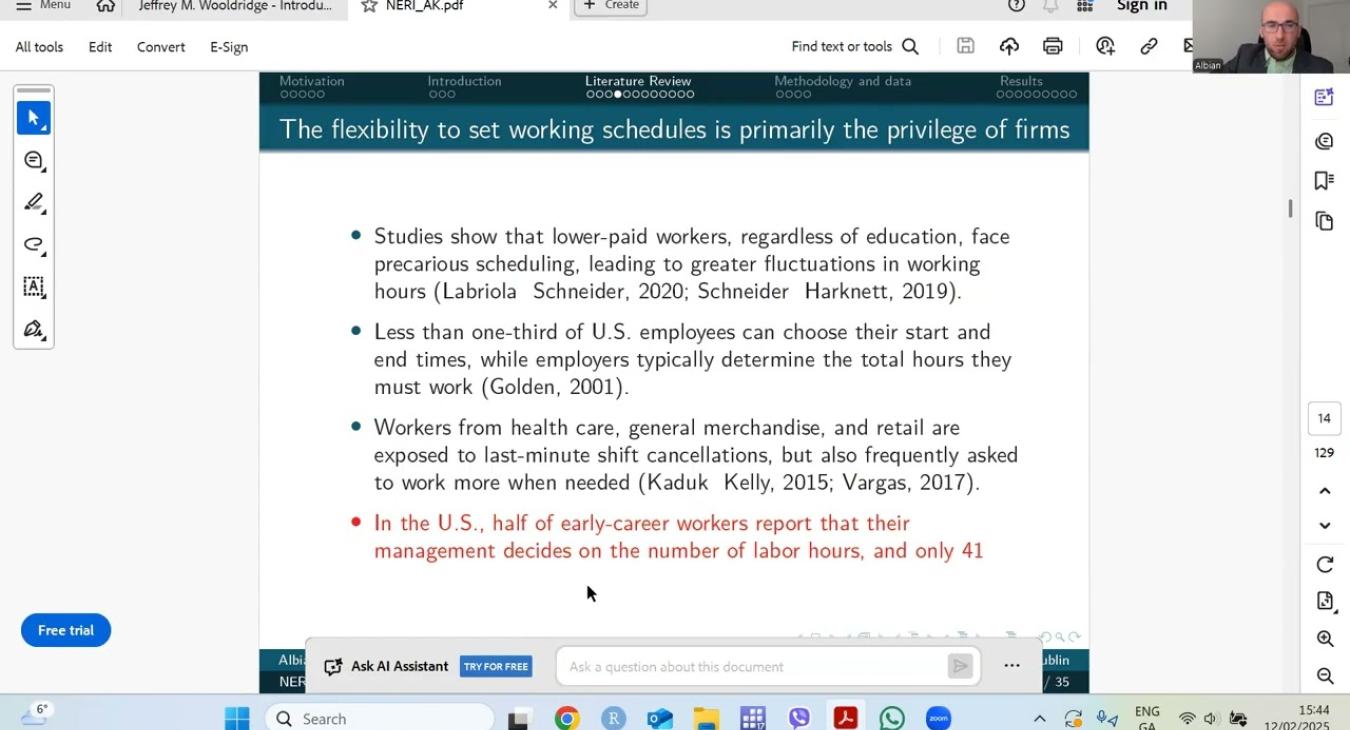
The NERI seminar titled 'Exploring Working Hours Disparities in Europe' was presented by Albian Krasniqi, PhD researcher and lecturer at TU Dublin.

It took place on Wednesday 12 February 2025 at 15.30 as an online Zoom event. Please find the presentation from the seminar.

Lecture Format: 

Albian Krasniqi, TU Dublin made his presentation.  Subsequently, there was a Q&A section where the chairperson, NERI economist Ciarán Nugent presented questions from attendees to Albian.

Abstract:

Working hours profoundly influence workers' health, work-life balance, financial stability, and overall well-being. Since the 1990s, average working hours have decreased in most European countries. Yet, significant differences remain between Eastern and Western Europe, as well as within countries – across sectors and occupations. This study uses individual- and country-level (regional) data, applying a multilevel approach and unconditional quantile regressions, to explore the determinants of individual working hours. The findings highlight a clear East-West divide: in lower-paid occupations and sectors, workers in the East typically work more hours, while in higher-paid occupations and sectors, workers in the West tend to work longer. Country-level factors such as female workforce participation, national productivity, migration, and social benefits account for significant variations in working hours. Notably, female workforce participation and productivity have a stronger influence in Eastern countries, whereas migration has opposite effects: in the East, emigration is linked to longer working hours, while in the West, immigration corresponds to shorter working hours. These results carry important policy implications, particularly for countries where female labour force activity and productivity are lagging.

Biography of presenter:

Albian Krasniqi is a PhD researcher and lecturer at TU Dublin. He holds an MSc in Economics from the University of Prishtina, Kosovo, and an MSc in Development Economics from the University of Sussex, UK. Before pursuing his PhD, Albian served as an economist for the Ministry of Finance in Kosovo and worked as a teaching assistant at the University of Prishtina.

Employment and Job Quality
Wages and Incomes

Upcoming events

Wed, Sep 16 2026, 3:30 - 4:30pm
The Irish labour market: Recent developments and future growth
Online Zoom event
Thu, Oct 8 2026, 3:30 - 4:30pm
The Budget 2027: NERI Post Budget Analysis
Online Zoom event
Wed, Nov 11 2026, 3:30 - 4:30pm
European Attitudes to Basic Income: exploring women's perspectives
Online Zoom event

Latest

It’s wrong to assume that job quality is the enemy of job creation
job quality
A number of business organisations recently wrote to the Economy Minister...
New Labour Market Entrants, earnings, housing costs and living standards in 2024
Man and savings
This Research InBrief by NERI economist, Ciarán Nugent examines trends in...
Progress in Pay, But Not in Participation or Progression
money
Some of the results move in the right direction, but overall the picture is one...

Breadcrumb

  1. Home
  2. Videos
  3. Exploring Working Hours Disparities in Europe

Subscribe to our Mailing list

  • X
  • Facebook
  • YouTube
Logo

The Nevin Economic Research Institute is a Registered Charity since the 1 August 2013 with the Charity Number - 20082130.

Privacy and Cookies

We use necessary cookies to make our site work. We also use analytics cookies without user tracking to help us improve our site.

Cookie Policy | Privacy Statement

Website design and development by Infobo.

Contact us

  •  Address: 31/32 Parnell Square, Dublin 1, Ireland
  •  Telephone: +353 1 8897722
  •  Email: [email protected]
  •  Address: 45-47 Donegall Street, Belfast BT1 2FG
  •  Telephone: +44 28 902 46214
  •  Email: [email protected]
Copyright © 2025 Nevin Economic Research Institute. All rights reserved.

Footer

  • Contact
  • Privacy
  • Cookie policy
  • Themes
    • A New Economic Model
    • Wages and Incomes
    • Employment and Job Quality
    • Climate and the Just Transition
    • Taxes and the Welfare State
    • Understanding the Labour Market
  • Our Work
    • Research
    • Blog
    • The NERI videos series
    • Learning about our economy
    • Media
    • Visualising our economy
  • Dashboards
    • Broad sectors
    • Subsectors
  • Events
    • External event contributions
  • About
    • Our team
    • Our supporters
    • Charities Governance Code
  • Contact
Clear keys input element