


The number of employees on the Coronavirus Job Retention Scheme on December 31st in Northern Ireland was just shy of 95,000.
This equates to about 12% of all employees - indicating just how important the job retention scheme has been at protecting the incomes of a significant proportion of workers through the crisis – and serving as a stark reminder that the security and protection provided by the scheme is the only reason that we have not seen a tidal wave increase in unemployment and why the latest labour market stats also released this week were well, so unremarkable.
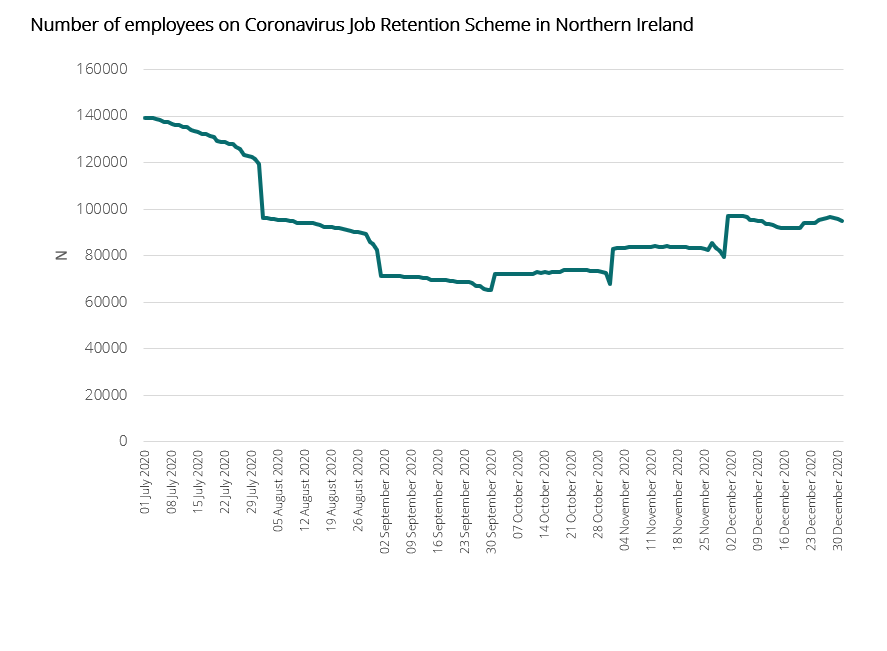
Looking at changes to the number of employees on the job retention scheme overtime we see from the graph above that there has been a number of step-change increases in the number of employees furloughed since the low point of 65000 at the end of September and we began to pivot back into lockdowns starting with the regional lockdown of Derry/Strabane in October and then of national lockdown in November when Chancellor Rishi Sunak was forced to announce he extension of the job retention scheme until April 2021. Not even the brief ease out of lockdown through a period of December done enough to really stifle the continued rise of the number of employees furloughed through the last number of months.
Who's furloughed?
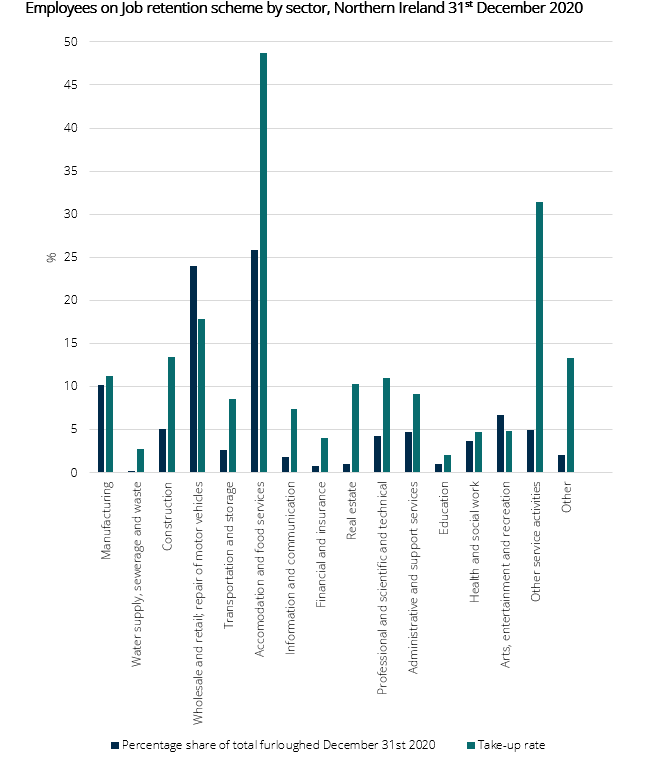
Due obviously to the nature of the public health restrictions in place, the job retention scheme is utilised in some sectors much more than others with close to 50% of all employees on the job retention scheme on 31st December 2020 employed in either the ‘Accommodation and Food services’ sector or ‘Wholesale & Retail sectors’.
‘Accommodation and Food services’ has by far the highest take-up rate with close to half of all employees from the sector utilising the job retention scheme. The second highest take-up rate is in the ‘Other service activities’ sector which includes activities such as hairdressing and other personal services where about 1 in 3 employees were utilising the scheme on 31st December 2020.
The high take-up rate for those in the ‘Accommodation & Food services’ s and ‘Other services’ sectors is perhaps unsurprising given that we know that hospitality has been forced shut by public health regulations. There is also an expectation that a large proportion of these workers will transition back into job for which they are being furloughed once public health restrictions are lifted and businesses are allowed to reopen. The longer the public health crisis goes on however the less likely, not least because people's consumption patterns may have changed quite drastically when we come out the other end.
However, some other sectors have perhaps higher take-up rates than we might have thought they would. Most notable perhaps in this regard is the ‘Manufacturing’ and ‘Professional, Scientific and technical activities’ sectors where about 11% of total employment in each was furloughed on 31st December 2020. These sectors are perhaps one which we have thought are less affected by lockdown restrictions as manufacturing has been exempt from the public health restrictions to shut, and an assumption that professionals are working away in their ivory ‘homes’ patiently awaiting the day that their offices reopen and they can get back to their chai lattes. For these reasons then, it is not at all that clear, who among these sectors and why they are using the job retention scheme.
There is of course a multitude of reasons as to why different sectors might be utilising the job retention scheme for their workers but ultimately the most important question when looking ahead to the planned end of the job retention scheme in April of this year is whether or not workers will transition back into the job for which they are being furloughed? How many of the jobs currently furloughed are going to remain viable out the other end?
For example, we might speculate that perhaps the take-up of the job retention scheme in the manufacturing sector is primarily being driven by those who would have been working in food production providing goods for the hospitality sector. The thinking here is that because the hospitality sector is shut down at present the activity within the manufacturing sector required to feed into that sector is not needed at present. But, should we automatically expect that as public health restrictions in the hospitality sector are lifted that activity in that sector and in-turn the activity of the supply chains will resume as normal?
As we progressed out of the first lockdown there was an optimism that we could emerge largely unscathed and that activity would largely return to how and where it was before. But, we've came a long way since then and the longer the public health crisis goes on it becomes less and less clear how much job recovery and job destruction we might expect as we re-emerge.
Of course, furlough statistics can tell us a lot about which sectors policy should be most concerned about, as can any data capturing which sectors are driving any increases in unemployment and economic inactivity. The fact that we know that we have to transition 1 in 10 workers from the manufacturing sector off the furlough scheme and back to work is good to know. But we need to learn more about the reasons they were furloughed in the first place before we can make educated guesses about their likelihood of returning to the same job.
Policy needs to move fast though to think about how we can ensure that the excellent work which the job retention scheme has done in weathering the labour market through the storm is not lost as we unbatten the hatches. If we can learn any lessons from previous crises it is that we can expect change. Things will not go back to how they were.
The risk of change is much greater in some sectors than it is in others, and as a result some workers face much higher risks of displacement than others.
Through utilising interventionist industrial policies we can sail the ship through what is going to be the bumpiest part of the journey for our labour market and protect viable jobs, smooth the reallocation of labour across sectors and ultimately ensure that workers who are displaced from their jobs are not displaced onto an unemployment heap.