


This weeks blog is by Ciarán Nugent, NERI economist. Although the country still had significant restrictions for the first three weeks of January, this is the most ‘normal’ quarter since the final quarter of 2019, though some sectors were still under various restrictions for the first three weeks in January. At the same time, income and wage supports were yet to be fully wound down and were a still a strong feature in several sectors, propping up employment, which may now come under pressure as they are discontinued (mostly by April).
The latest figures show 158,000 more in employment at the beginning of 2022 than two years before at 2.5 million, 237,000 (or 9.5%) of whom were still supported by the state at the end of March.
Over the last number of weeks, the latest labour force survey data covering the first quarter of 2022 (January, February, March) was released by the CSO, including estimates of employment growth by gender, sector and age group. We also have breakdowns by various indicators of the nature of that employment for the final quarter of 2021 (part-time/temporary etc.). In addition, details of average earnings by hour, by week, by sector as well as the number of paid hours worked by sector were released from the Earnings, Hours and Employment Costs (EHECS) survey.
Although the country still had significant restrictions for the first three weeks of January, this is the most ‘normal’ quarter since the final quarter of 2019, though some sectors were still under various restrictions for the first three weeks in January. At the same time, income and wage supports were yet to be fully wound down and were a still a strong feature in several sectors, propping up employment, which may now come under pressure as they are discontinued (mostly by April).
The latest figures show 158,000 more in employment at the beginning of 2022 than two years before at 2.5 million, 237,000 (or 9.5%) of whom were still supported by the state at the end of March.
Not only have we record numbers in employment, over the two years we’ve seen the share of inactive working age adults fall more than in the previous 8 years of post-financial crisis recovery, driven by higher numbers of younger workers and female workers. There were 100,000 fewer inactive adults at the end of 2021 than the start of 2020 (850-750,000). The employment rate surpassed that of 2007 for the first time as well. Although we had consistent employment growth from 2012, the share of workers when considered relative to the growing working age population remained almost static for five years up to 2019.
There has been strong growth, mostly in 2021 in some of the most important sectors with some of the highest wages in Ireland. Though there are different estimates, employment in Information and Communications grew by about a third or 25% depending on the survey (from 127,000 to 163,000 or 113,000 to 151,000 employees according to LFS data or 79,000 to 103,000 employees in EHECS). All estimates showed a drop off between the end of 2021 and the first quarter of 2022 however leading one to wonder whether this strong growth is embedded or may have been facilitated with the unique circumstances of covid (opportunities to work from home, lockdown-specific complexities/opportunities around childcare etc.). According to the breakdown in LFS data a significant share of this growth was taken up by workers over 40 and a significant share was filled by foreign nationals (16,000 out of 35,000 or 45%) bringing the share up to 33% for the sector, almost twice the national share of 17.6%.
We also saw strong growth in Professional, Scientific and Technical activities another highly paid sector of 25,000 up to the final quarter in 2021. These gains were almost halved however (a drop of 11,000 to 162,000) in one quarter at the start of 2022. In addition, employment in Financial, Insurance and Real Estate were up by 15,000 and are highly paid jobs on average.
Between Pubic Admin, Health and Education (mostly associated with the public sector) there were 75,000 net new jobs in the first quarter of this year compared to two years previous (almost half the net growth over the period).
Employment in Hospitality was about 3% lower in the first quarter compared to the first quarter of 2020. Wages in this sector are by far the lowest of any sector in Ireland (out of 14) and precarious work is a strong feature of employment. Indeed, the share of part-time employment in the sector went from 41% in early 2020 to 52% over the pandemic (Q4 2021).
Growth in some of the higher paid sectors has translated into disproportionate growth in the share of high end occupations in Irish employment (SOCCODE), clearly a good thing. Over two years, approximately 140,000 out of 158,000 new jobs (net), were at the top of the skill/wages spectrum; 40,000 more in Management positions and 37,000 more Professionals (though this dropped off by an estimated 15,000 in the latest quarter) and approximately 50,000 new Associate Professional positions. At the same time, in the next quarter (April to June), when restrictions were fully lifted for the entire quarter we’re likely to see upon release of that data (all things going smoothly) catch up in sales and customer service, caring, leisure and other services and elementary occupations within Retail and Accommodation and Food as well as Skilled trades and Process, Plant and Machine operatives in Construction.
Though we don’t have the breakdown for the latest quarter, a disproportionate share (41%) of growth over the pandemic up until the end of 2021 was part-time work (57,000 new jobs compared to 80,000 full-time). This was almost twice the rate of part-time employment in the labour market as a whole. This is reflected in a slight reduction in average hours per worker, down to 32.3 from 32.5.
The latest earnings data has shown strong nominal growth both in hourly and weekly earnings. However, considering inflation (now over 8%) the picture is not as rosy and may have implications for some sectors such as retail and hospitality in the coming quarters.
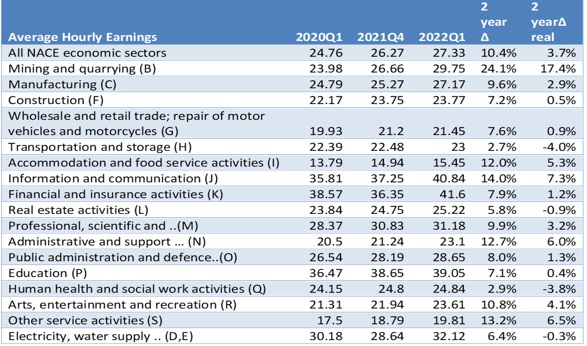
Looking at real wage trends over two years from Q1 2020 and Q1 2022, the Consumer Price index increased by 6.7% while hourly earnings increased by 10%, translating to 3.7% real term growth (less than 2% on average per annum). Strong real term growth was recorded in Mining and Quarrying and in IT, though most sectors saw little improvement. Health workers (public and private) experienced a real term drop by almost 2% a year over two years in hourly earnings.
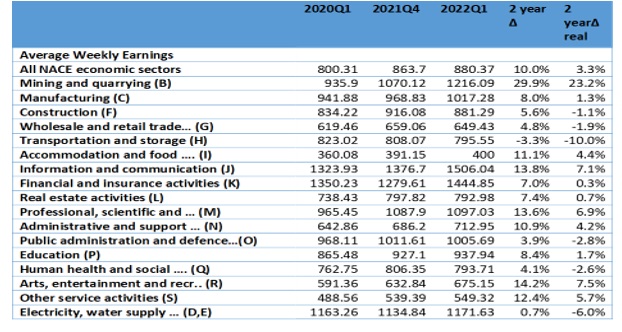
Real weekly earnings grew strongly for Mining and Quarrying, IT, Professional, scientific and Technical activities as well as Arts, entertainment and recreation and were up 3.3% on average over two years. Weekly earnings fell in real terms in 6 out of 17 sectors including in many frontline staff sectors like Retail and Health as well as in Construction and Public Administration.
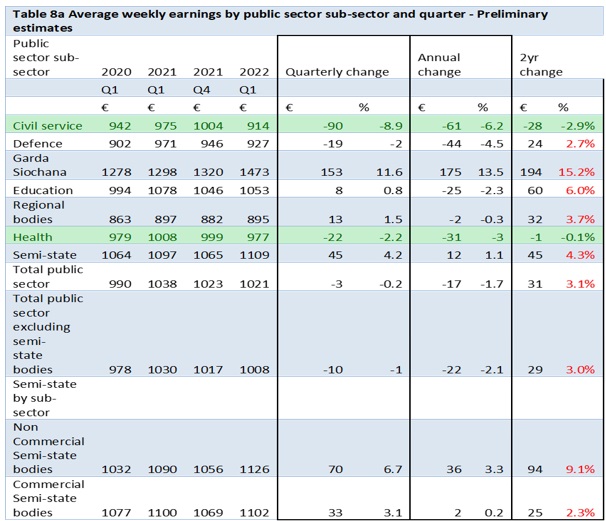
Other than in the Gardaí, average weekly wages have fallen in real terms for all types of public sector workers over the pandemic with the average public sector worker down 3.6% per week in 2022 over two years. Within the public sector, Civil Servants were down almost 10% in weekly earnings and Public Health workers were down almost 7% (this included a slight nominal decline).
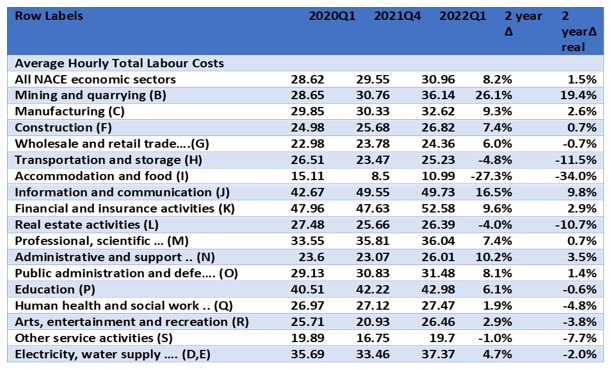
Average labour costs grew 8.5% over two years (just 1.5% in real terms). In Hospitality, labour costs were down by a third in real terms and 27.3% nominally, due to a disproportionate number of employments supported by the state through the EWSS. In the final quarter of 2021, two thirds of employments in the sector were subsidised by the state covering 42% of the wage bill for the entire sector. As recently as the end of April, the earnings of 98,000 workers in the sector were still subsidised by the state, with virtually no change over 8 or 9 months and significantly higher than in the same period last year. (In totally unrelated news, I paid 7 euro for a basket of sweet potato fries in March on Capel street. 3 stars.)
The share of households and workers unable to afford the basic costs of a minimum essential standard of living increased in 2019 as the cost of living crisis really began to bite. This was driven by renters and younger adults, especially younger women. This was despite strong growth in employment, wages and GDP.
Without appropriate intervention on the minimum wage and welfare rates, we will see a lot more people fall into material deprivation in 2022.