

Authors: Paul Mac Flynn & Lisa Wilson
The Prime Minister Boris Johnson announced a significant hike in National Insurance Contributions on Tuesday. One of the more surprising claims to have surfaced from the commentary of many policy analysts is that this tax hike, alongside those announced earlier in the year (corporation tax), represents an end to low tax Conservatism. It is almost as if the Conservative Party has truly shifted the UK to a ‘big state’ society.
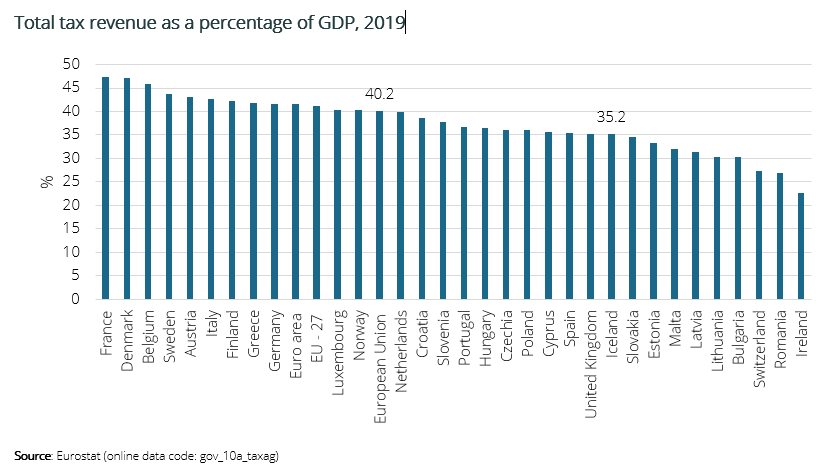
The truth is that while the announcements might go some way to altering UK’s relative tax revenue position (all else remaining equal), in 2019 (the latest year for which there is internationally comparable data available) tax revenues in the UK as a percentage of GDP were amongst the lowest of EU-28 countries. Similarly, UK tax revenues are slightly below average when compared to both the G7 (36%) and OECD (34%) countries. Over a longer period, tax revenues in the UK have risen by less than in most other advanced economies and even in its own historical context, UK tax revenues are lower than their historical average. The UK has gone from being a high-tax country in the 1960s to a relatively low-tax country today.
Nonetheless, yesterday’s announcement does beg a number of questions. Is a tax increase necessary? Is the tax increase being introduced via the most suitable policy lever? Is the hypothecation of the tax increase for health and social care the right choice?
In terms of the detail that we know at present. From April 2022, the employee, employer and self-employed rates of National Insurance (NI) will rise by 1.25 per cent. Tax on share dividends will also be increased by 1.25 percentage points. The increased revenue from these increases will go initially towards easing pressure on the NHS. The intention thereafter is to have these increases formally hypothecated as a Health and Care Levy in April 2023.
The announcements are estimated to bring in an additional £11.2 billion for the Department of Health and Social Care in 2022−23, and £9.0 billion in 2023−24. Of that, around £1.8 billion each year is earmarked for social care for the next three years (to be reviewed thereafter). The remaining £9.4 billion of additional funding in 2022−23, and £7.2 billion in 2023-24 is earmarked to deal with health-related Covid pressures. Northern Ireland is expected to receive an additional £420m under the plans.
In terms of whether or not the tax increase was necessary, a number of factors need to be considered. It is not true to say that all increases in public spending must be met with increases in taxes. Our recent experience of the pandemic era increases in expenditure are proof enough of that. The UK as a currency issuing economy has significant flexibility to fund public expenditure without raising taxes to support it. However, in order to maintain that currency tax revenues over the medium to long term must rise to meet the obligations of servicing that expenditure.
It is also probably fair to say, that even without the pandemic the UK public finances were facing ongoing, and unsustainable pressures owing to issues such as an ageing population and so without making unsustainable cuts to public expenditure, tax rises were always inevitable. These pressures on public services have obviously been exacerbated by the pandemic, and with that increased pressure there is a renewed confidence and realisation amongst citizens that austerity and public expenditure cuts are not a viable option. However, there is also a realisation among the public that moving toward greater public service provision is not a cost-free exercise.
If the public are generally accepting of a need for increased tax revenue, then why was there such negativity in the public commentary on yesterday’s policy announcement? Much of the criticism has been levelled at the type of tax increase that the government has sought to utilise. A tax increase focused on labour income leaves several other sources of income undertaxed – including taxes on rental income or capital gains. For example, analysis by the Resolution Foundation on the tax rise shows that a typical 25-year-old today will pay an extra £12,600 over their working lives from the employee part of the tax rise alone, compared to nothing for most pensioners.
Even if we were to ignore the other forms of income that the government could have sought increased revenues from, the government has still got the balance wrong within taxes on labour. The latest internationally comparable data show that UK collects amongst the lowest proportions of all of its taxes from labour income, compared to similar advanced economies. And as the data presented in the graph below show, the majority of the gap in labour taxes per person arise from the UK’s lower yield from social contributions compared to both the Republic of Ireland and other similarly advanced economies. In this sense, increasing our proportional share of taxes raised via labour income will not put the UK out of step on a competitive basis as some are claiming. On the basis of the chart below, it would seem as if the government have made the right call, but this is only one part of the picture.

Within social contributions, the gap between the UK and other advanced economies is not shared evenly between employees and employers. Compared to other advance European economies, the UK collects almost 70% of the average in employee social contributions, but it collects only 40% of the average revenue from employers. This should have been reflected in Tuesday’s announcement. Any increase in national insurance should have reflected this glaring existing imbalance. That being said, given the more regressive nature of national insurance contributions in the UK compared to income taxes there does remain an argument for the increase at least on employees to have been made via the income tax system, rather than the national insurance system.
The final question posed was whether the proposed increase in national insurance should be linked to Health and Social Care. Many have decried to juxtaposition of young working families being asked to pay for the social care of possibly wealthy older citizens who are being asked to contribute nothing. This is a more fundamental question and it leads to a dangerous precedent where citizens come to believe that taxation is transactional relationship and people should only have to pay for things that benefit them directly. Taxes should be paid by all who are able for the benefit of all in need. That being said, the fact that after our experience of this pandemic, there was no mention of building a proper system of social security was glaring omission.
We do need to raise more tax revenue and such measure should be broad enough to cover all forms of income and bring proper equity to our system. We do need to spend more money on our health service, but to think that this was the only public service deficit exposed by the pandemic is utterly incorrect.