
In this week's blog, NERI Co-director Paul Mac Flynn discusses the Northern Ireland draft Budget for 2021/2022.
Last month, the Minister for Finance Conor Murphy outlined a draft Budget for 2021/22 to the Northern Ireland Assembly. In the context of the pandemic and a period of unprecedented increases in government spending, one might expect an event such as a budget to create a bit of a splash. Why did Northern Ireland’s budget end up as a bit of a damp squib then?
There are two main reasons for this. Firstly, the rapid and far reaching expansion of public expenditure in Northern Ireland over the last year occurred outside of the budgetary process. The Northern Ireland Budget for 2020/21 contained only £120m for a Covid response because it was finalised just as lockdown began in late March and early April of 2020. By the time real amounts money started flowing in from Westminster, it was too late to become part of the budget here. All of nearly £3bn in Covid funding given to Northern Ireland has been managed on an ad-hoc basis. While Covid funding will be captured in this year’s budget, it is a significantly smaller amount than last year. In years to come, researchers may look back at Northern Ireland’s pandemic budgets and wonder what all the fuss was about.
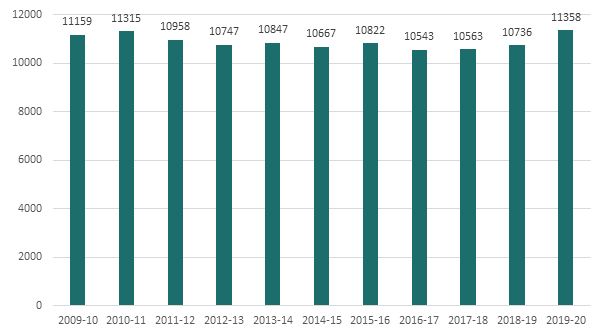
The second reason why this budget landed a bit flat is much more important. Once you strip Covid supports out of this budget, the prospects for public expenditure look pretty grim. The Spending Review 2020 set the tone for this year’s budget and it makes for grim reading. Day to day expenditure actually declines in cash terms. Adjusting for inflation, this would actually imply cuts to current expenditure on public services. It would see us return to the same roll-over budgetary cycle we have been on for over 10 years.
Chart 1: Real terms Current Spending in Northern Ireland 2009 to 2020
The fact that government expenditure has stepped in to stabilize the economy and preserve it during this pandemic has been instructive. It shows that governments do have the capacity prevent depressions and provide the ultimate economic security. However, it would be quite foolish to think that the experience of this pandemic has radically shifted political thinking about the role of the state.
It is quite likely that once the emergency stage of this pandemic is over and the economy begins to open up again, the drumbeat of austerity will begin to sound again. Expect to hear sermons extolling the virtues of “living within our means” and “balancing the books”. It is quite likely that the agents of austerity from 2010 have learned nothing from this latest experience.
If fiscal contraction is going to be the post-pandemic response of the UK government, then all of our efforts to stabilize the economy during the pandemic will have been in vain. The post-pandemic economy will require the same level of urgency and attention that the pandemic economy did. If we attempt to go back to the normal course of events, the economic collapse that we have spent the last year trying to avoid will simply unfold slowly over the following months.
Yes, there is likely to be a significant upswing as we re-open the economy, but it would be foolish to think that the economy will not require sustained support over the next few years. A consumption boom in the latter half of this year will not stave off the economic impact of this pandemic. Expecting the economy to bounce back after the pandemic is like expecting someone who just had heart surgery to resume an active lifestyle. Moving back to normal too quickly risks everything.
That is the danger for Northern Ireland in this latest budget. Look beyond Covid supports and we are heading back to the long tail of austerity that we were on before the pandemic hit. This would be a grave error.