
  • X
  • Facebook
  • YouTube

Top header menu

  • Sign up to our mailing list
Home
  • Themes
      1. A New Economic Model
      2. Wages and Incomes
      3. Employment and Job Quality
      4. Climate and the Just Transition
      5. Taxes and the Welfare State
      6. Understanding the Labour Market
  • Our Work
      1. Research
      2. Blog
      3. The NERI videos series
      4. Learning about our economy
      5. Media
      6. Visualising our economy
  • Dashboards
      1. Broad sectors
      2. Subsectors
  • Events
      1. External event contributions
  • About
      1. Our team
      2. Our supporters
      3. Charities Governance Code
  • Contact

Topics

  • A New Economic Model
  • Wages and Incomes
  • Employment and Job Quality
  • Climate and the Just Transition
  • Taxes and the Welfare State
  • Understanding our Labour Market

Trade Unions, Collective Bargaining and Economic Performance

NERI Research inBrief no 68 June 19
Blog
 June 
25,
 2019
Profile picture for user Dr Tom McDonnell
  By Dr Tom McDonnell

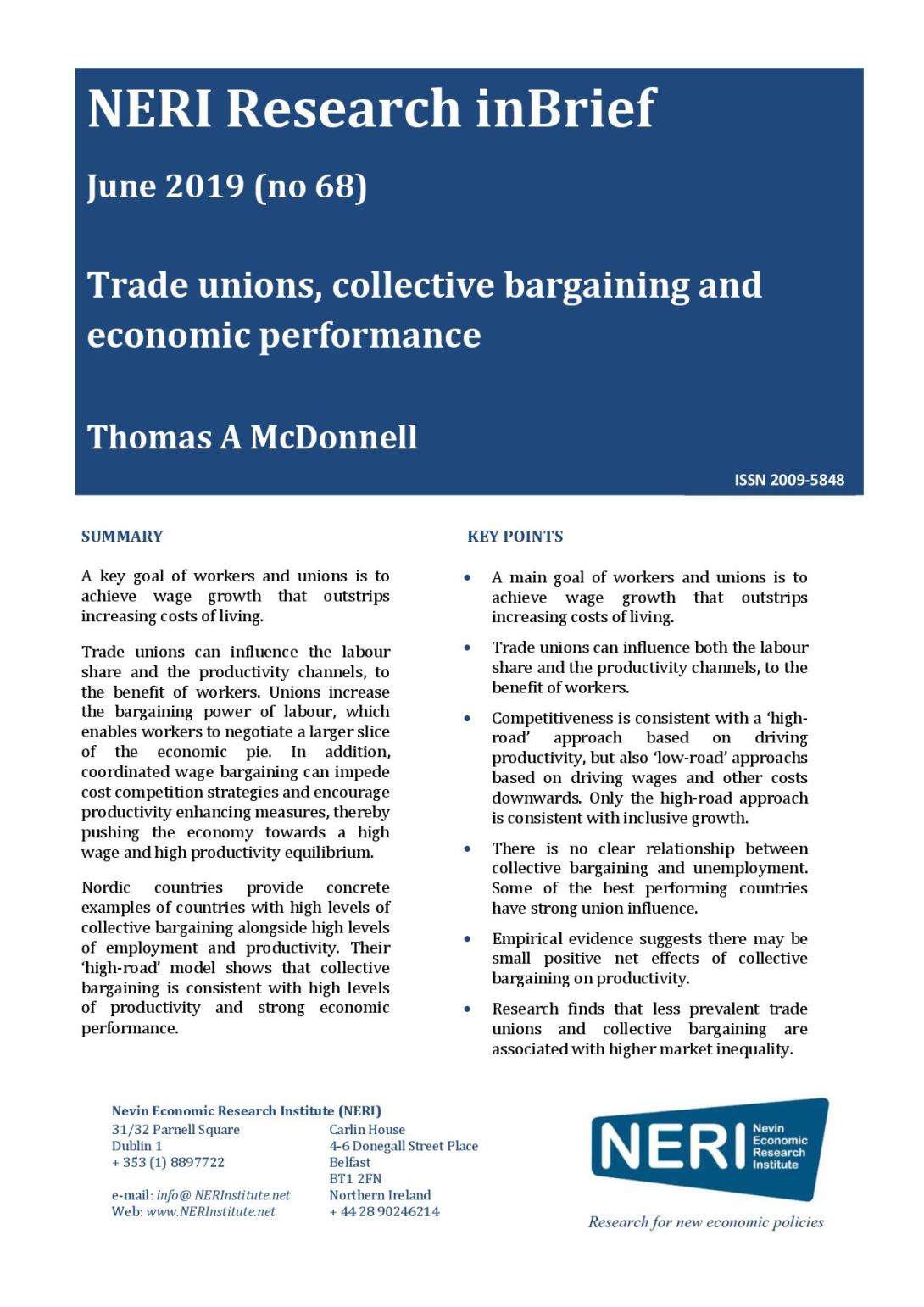
A key goal of workers and unions is to achieve wage growth that outstrips increasing costs of living.

Trade unions can influence the labour share and the productivity channels, to the benefit of workers. Unions increase the bargaining power of labour, which enables workers to negotiate a larger slice of the economic pie. In addition, coordinated wage bargaining can impede cost competition strategies and encourage productivity enhancing measures, thereby pushing the economy towards a high wage and high productivity equilibrium.

Nordic countries provide concrete examples of countries with high levels of collective bargaining alongside high levels of employment and productivity. Their ‘high-road’ model shows that collective bargaining is consistent with high levels of productivity and strong economic performance.

Some key points:

·1. Trade unions can influence both the labour share and the productivity channels, to the benefit of workers.

·2. Competitiveness is consistent with a ‘high-road’ approach based on driving productivity, but also ‘low-road’ approachs based on driving wages and other costs downwards. Only the high-road approach is consistent with inclusive growth.

·3. There is no clear relationship between collective bargaining and unemployment. Some of the best performing countries have strong union influence.

·4. Empirical evidence suggests there may be small positive net effects of collective bargaining on productivity.

5. Research finds that less prevalent trade unions and collective bargaining are associated with higher market inequality.

The latest NERI inBrief reviews some of the theory and evidence here.

Profile picture for user Dr Tom McDonnell

Dr Tom McDonnell

Tom McDonnell is co-director of the Nevin Economic Research Institute and is based in the Dublin office. In addition to managing staff in the Dublin office he has co-responsibility for the NERI's research programme and for its strategic direction.  

He is also responsible for, among other things, the NERI's analysis of the Republic of Ireland economy including risks, trends and forecasts. He specialises in economic growth, economics of innovation, Irish and European economies, and fiscal policy. 

He previously worked as an economist at TASC and before that was a lecturer in economics at NUI Galway and at DCU. He has also taught at Maynooth University (MU) and is currently an occasional staff member at MU. 

Tom obtained his PhD in economics from NUI Galway. He is a native of Limerick city and lives in Maynooth.

Contact: [email protected] or 00353 1 889 77 42.

Upcoming events

Wed, Sep 16 2026, 3:30 - 4:30pm
The Irish labour market: Recent developments and future growth
Online Zoom event
Thu, Oct 8 2026, 3:30 - 4:30pm
The Budget 2027: NERI Post Budget Analysis
Online Zoom event
Wed, Nov 11 2026, 3:30 - 4:30pm
European Attitudes to Basic Income: exploring women's perspectives
Online Zoom event

Latest

It’s wrong to assume that job quality is the enemy of job creation
job quality
A number of business organisations recently wrote to the Economy Minister...
New Labour Market Entrants, earnings, housing costs and living standards in 2024
Man and savings
This Research InBrief by NERI economist, Ciarán Nugent examines trends in...
Progress in Pay, But Not in Participation or Progression
money
Some of the results move in the right direction, but overall the picture is one...

Breadcrumb

  1. Home
  2. Blog
  3. Trade Unions, Collective Bargaining and Economic Performance

Subscribe to our Mailing list

  • X
  • Facebook
  • YouTube
Logo

The Nevin Economic Research Institute is a Registered Charity since the 1 August 2013 with the Charity Number - 20082130.

Privacy and Cookies

We use necessary cookies to make our site work. We also use analytics cookies without user tracking to help us improve our site.

Cookie Policy | Privacy Statement

Website design and development by Infobo.

Contact us

  •  Address: 31/32 Parnell Square, Dublin 1, Ireland
  •  Telephone: +353 1 8897722
  •  Email: [email protected]
  •  Address: 45-47 Donegall Street, Belfast BT1 2FG
  •  Telephone: +44 28 902 46214
  •  Email: [email protected]
Copyright © 2025 Nevin Economic Research Institute. All rights reserved.

Footer

  • Contact
  • Privacy
  • Cookie policy
  • Themes
    • A New Economic Model
    • Wages and Incomes
    • Employment and Job Quality
    • Climate and the Just Transition
    • Taxes and the Welfare State
    • Understanding the Labour Market
  • Our Work
    • Research
    • Blog
    • The NERI videos series
    • Learning about our economy
    • Media
    • Visualising our economy
  • Dashboards
    • Broad sectors
    • Subsectors
  • Events
    • External event contributions
  • About
    • Our team
    • Our supporters
    • Charities Governance Code
  • Contact
Clear keys input element