

In this week’s blog, NERI economic consultant, Dr Aoife Ní Lochlainn discusses the Sixth Carbon Budget and the contribution of Northern Ireland.
This week sees the publication of the UK’s Committee on Climate Change (CCC) Sixth Carbon Budget under the Climate Change Act. The carbon budget will set the target for greenhouse gas emissions reductions for the UK for the period 2033-2037. It will also set out the pathway for meeting the Net Zero target for 2050 legislated for in 2019. While the targets are UK-wide, each devolved government is free to set out more ambitious targets. Scotland has already risen to this challenge, setting a net zero target for 2045. Of the devolved governments, Northern Ireland is the only one not to have targets set out in law or a specific framework for meeting such targets. Many of the levers required for climate mitigation policies are devolved or partially devolved, making it more important that the devolved administrations have legislative frameworks which enable coherent policy-making.
The Sixth Carbon Budget will set out sector by sector emissions pathways for each of the devolved governments. The Committee will also propose a “fair contribution” for Northern Ireland towards the UK effort for decarbonisation. Although it makes up just 3% of the UK population, Northern Ireland currently accounts for approximately 4% of the UK’s GHG emissions. While the carbon budgets for the 2030-40s provide important signals for investment, both public and private, there is pressure to increase the interim 2030 targets and frontload emissions reductions. This pressure stems from those who advocate greater earlier action for both moral and economic reasons. Reports of record breaking heat over the last decade provide a scientific argument for accelerating, or front-loading emissions reductions. The economic argument of greater cost effectiveness, articulated forcefully in the Stern Report of 2006, has also been made by the Committee itself in its Fourth Carbon Budget: “pathways with early [domestic] action…are more cost-effective over time than pathways which delay action towards meeting the 2050 emissions reduction target.”
The UK Government is under political pressure to set ambitious targets, given its upcoming hosting of COP26 (rescheduled for 2021 due to the pandemic) and its promise of a Green Brexit. Boris Johnson recently announced a UK-wide 2030 target of 68%. While this is a significant increase on its previous target of 57% there was some disappointment amongst campaigners, who had made the argument for a 70-75% reduction.
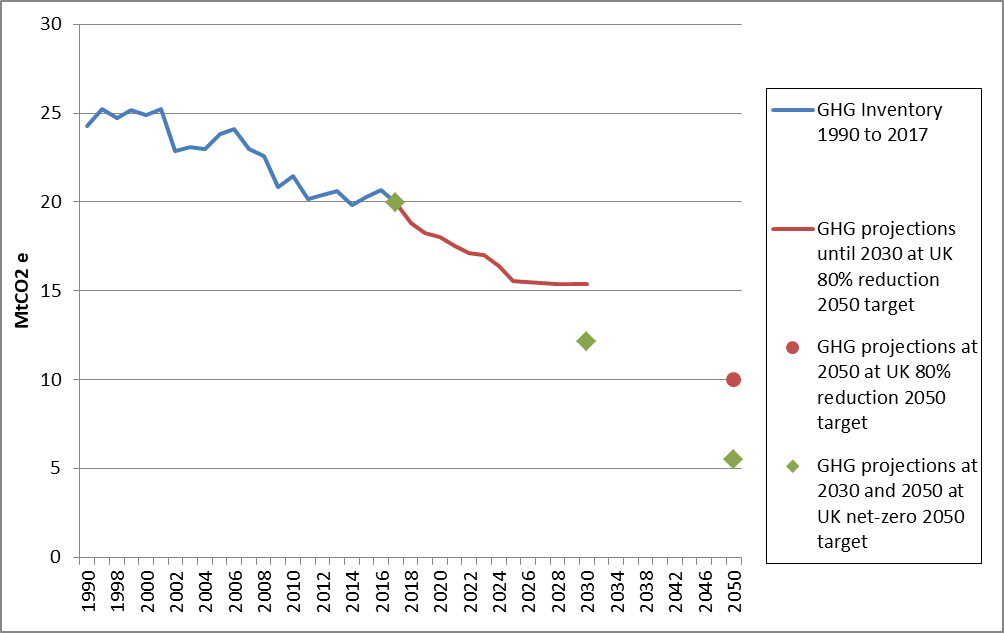
These new UK-wide 2030 and 2050 targets will inevitably mean new more onerous targets for the devolved governments. The Fifth Carbon Budget under the Act set a target for Northern Ireland of a 35% reduction in GHG emissions by 2030. The Northern Ireland executive of 2011-2016 set a target of 35% by 2025 in its Programme for Government. The chart below shows the gap between the current 80% reduction target by 2050 and the net zero target at both 2030 and 2050 as estimated by the CCC earlier in 2020. There is a gap of 4-5MtCO2e, which is equivalent to moving from a 63% reduction on 1990 levels to a 78-80% reduction on 1990 levels.
Northern Ireland GHG emissions historical and targeted at the 80% and Net-Zero targets
Source: DAERA (2020) ‘Northern Ireland Greenhouse Gas Projections based on 2017 GHG inventory’; CCC (2019) ‘Net Zero: The UKs contribution to stopping global warming’.
The Committee, in examining the profiles and challenges for each country in the UK has published indicative targets for the devolved governments in its earlier report. Each country has its own economic, biogeographic and industrial history, which present different opportunities and challenges to decarbonisation. Scotland, for example, a greater capacity for emissions removal through the Land-Use Change and Forestry (LULUCF) sector and is expected to meet a higher 2050 target.
Northern Ireland, on the other hand has an emissions profile more similar to that of the Republic of Ireland; its agriculture emissions are just over 27% nearly three times that of the UK. It is the only devolved administration where LULUCF is a source of emissions rather than a sink, for both geographic and socio-economic historical land-use reasons. Agriculture in Northern Ireland is dominated by cattle, sheep and dairy farming, (90%), which are the most emissions intensive farming activities. The Agrifood industry is an important employer, it accounts for approximately 70,000 full time jobs (NISRA and DAERA). Of these 70,000, over 49,000 are farmers and the remaining work in the manufacturing side of the industry. As such, as an industry and an employer, it is highly sensitive to any policies which may decrease the size of the cattle, dairy or sheep herds.
It is this sensitivity and land-use profile that informs the CCCs advice. Previous advice from the Committee on policy measures to reach the 80% target in Northern Ireland included: Developing a route to market for low-cost intermittent renewables, in particular onshore wind; replace the common agricultural plan payments with payments that are linked to agricultural emissions reductions and sequestration; increase the rate of tree planting; introduce a policy to incentivise homeowners to install low-carbon heaters, replace oil boilers with heat pumps; develop policy for delivering energy efficient improvements in homes targeted at low income households and finally, assist in more repaid deployment of electric vehicles. These policy options if properly implemented will deliver a reduction in emissions to Northern Ireland of 40% by 2030, they will not however, deliver the reduction needed to reach the net zero target in 2050 or its related interim 2030 target.
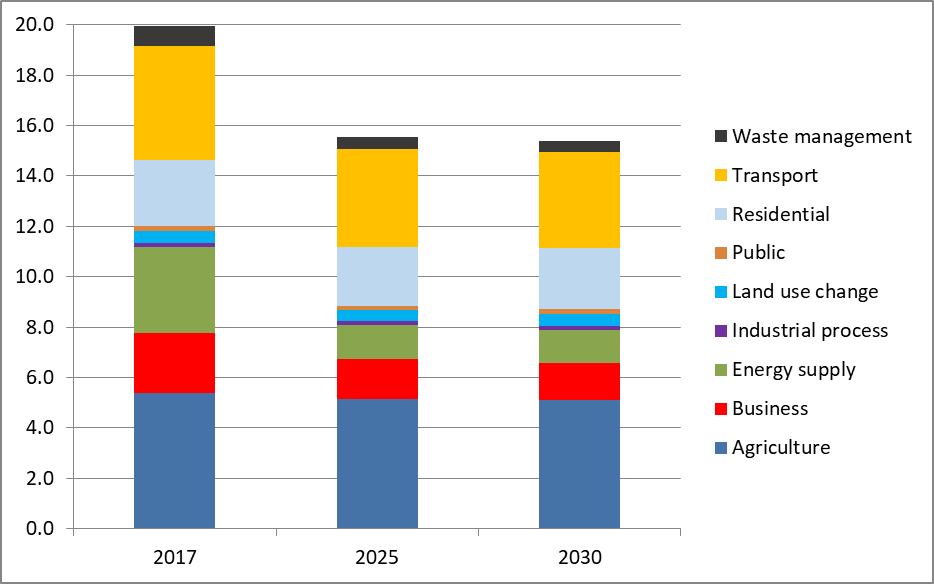
Until this year, Northern Ireland was expected to miss its 2030 targets of a 35% reduction on 1990 levels. However, recent projections by the Department of Agriculture, Environment and Rural Affairs (DAERA) have estimated that emissions reductions will in fact reach 37% by 2030. The chart below shows the emissions profiles and projected profiles for the years 2017, 2025 and 2030.
As can be seen below, the reduction in emissions from energy supply make up the largest saving; 61% from 2017 to 2025 and a further 0.6% from 2025 to 2030. This is followed by reductions in business and waste management.
Chart 1: Northern Ireland emissions 2017 and projected emissions 203
Source: DAERA (2020) Northern Ireland Greenhouse Gas Projections based on 2017 GHG inventory
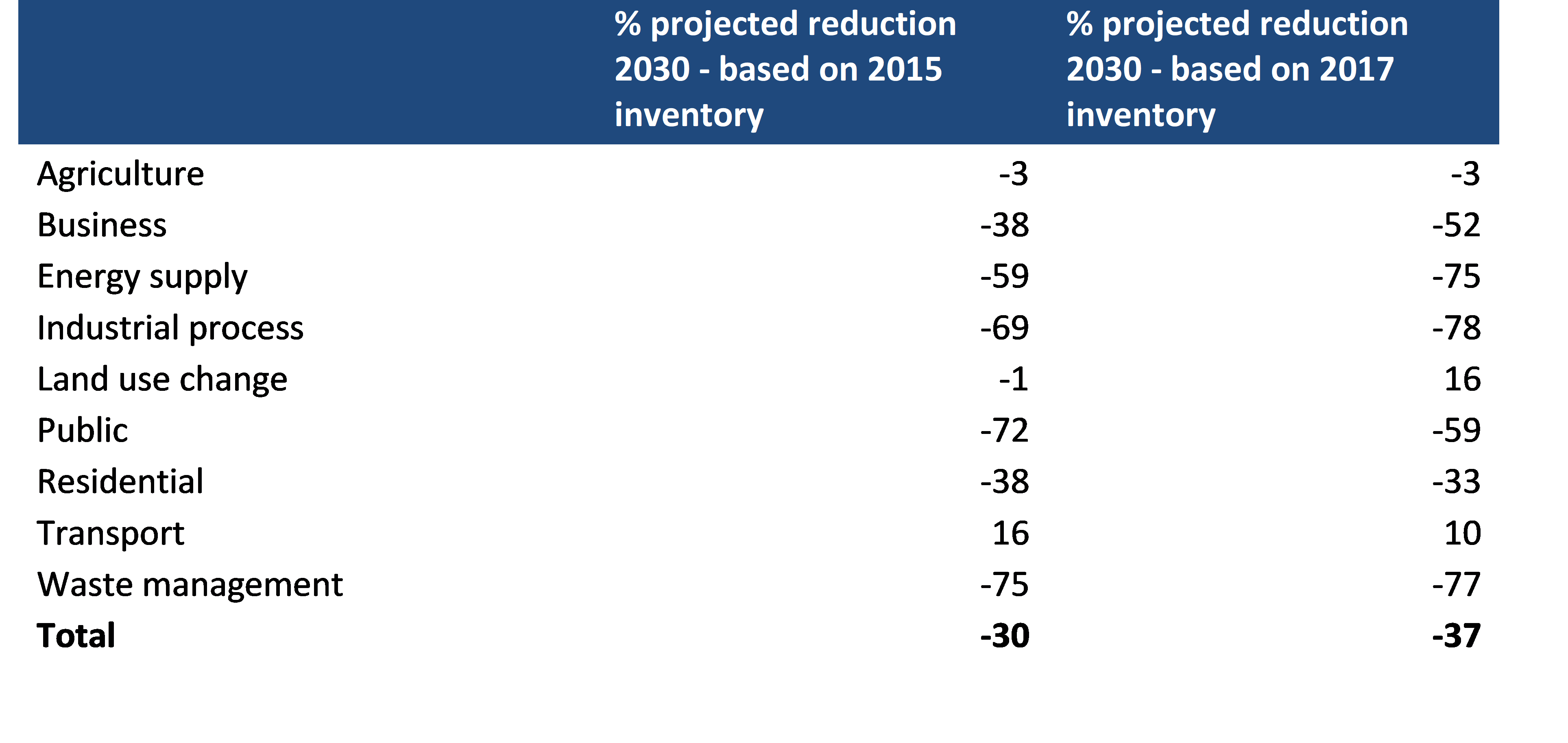
This acceleration in the reduction of energy emissions can be more clearly seen in the table below. Initially projected to reduce by 59%, this has increased to 75%. This projected increased reduction has been attributed to the closing of the Kilroot coal power station by 2024.
Percentage reduction in emissions by sector – comparison between 2015 inventory projections and 2017 inventory projections
Source: DAERA (2018) Northern Ireland Greenhouse Gas Projections based on 2018 GHG inventory DAERA (2020) Northern Ireland Greenhouse Gas Projections based on 2017 GHG inventory
There remain large challenges for emissions reduction in Northern Ireland. Due to its economic and land-use profile, the agricultural sector is not expected to reduce its emissions at similar rate/proportion to other sectors. These challenges and suggested policies and pathways are expected to be addressed by the CCC on Wednesday in both its UK-wide Sixth Carbon Budget and separately in advice for Northern Ireland.
Northern Ireland lags behind the other devolved countries in its legislative and policy response to climate change. The impact on emissions reductions from the stasis in policy making in Northern Ireland since 2017 can be seen in the projections for GHG emissions made by DAERA.
“Emissions are expected to decrease year-on-year until 2025 when they level off. The downward trend is mainly driven by the energy supply sector with Kilroot power station closing in 2024 contributing to the decrease between 2018 and 2025 before levelling off as no further policy savings are included.”
(DAERA, 2020, Report on Northern Ireland Greenhouse Gas Projections)
The all-party agreement re-establishing the government in early 2020, New Decade New Approach, commits to a “climate change Act with legally binding and ambitious sectoral emission reduction targets” and a new energy strategy which “will set ambitious targets and actions for a fair and just transition to a zero carbon society”. Consultation is underway on the energy strategy. A Climate Change Bill has not yet been published by the Minister. However, rather than wait any longer for a reluctant Minister to publish a bill, a private members bill, based on work by Climate Coalition Northern Ireland, will be introduced by Clare Bailey MLA and co-sponsored by Sinn Fein, SDLP, UUP, Alliance and Independent MLAs.
This bill contains a net zero target by 2045, rather than 2050, bringing it in line with Scottish ambitions. Most importantly it creates a framework for policy-making, monitoring and reporting, ensuring some level of accountability for decision-makers and a mechanism for public dialogue, a Climate Assembly. The Sixth Carbon Budget and the advice on the contribution of Northern Ireland will inform the process and illustrate the scale of the challenge; the passage of a climate bill with a decision-making framework is an important first step in meeting that challenge.