


by Paul Mac Flynn & Dr Lisa Wilson
The latest batch of labour market statistics from Northern Ireland Statistics and Research Agency (NISRA) were published this week with many reflecting that they highlight further improvements on the road to recovery. However, as important as it is to be optimistic about the buoyant performance of the labour market over recent months, it is important also to recheck into reality and remember that the labour market is still being propped up by the furlough scheme. What is more, the £20 uplift in universal credit introduced to ease the strain on living standards is due to be withdrawn at a time coinciding with the end of furlough. In this respect, the coming weeks end two of the most important rafts put into place to support workers through the pandemic, both of which are likely to result in real hardships for affected workers in the coming months. This blog focuses on 'What happens when furlough ends?' and 'What happens when the temporary increase to universal credit ends?'.
What happens when furlough ends?
The Coronavirus Job Retention Scheme is due to end at the end of this month. What happens then? Will unemployment rise? Not according to the Bank of England who have predicted that unemployment has peaked and will continue to slowly fall through September.
The Coronavirus Job Retention Scheme has been a key policy success in the Government’s handling of the Covid-19 pandemic since March 2020. It has held down unemployment rates below about 4%, prevented any drastic rise in the rate of economic inactivity – and ultimately has successfully supported a return to work for many as the economy has reopened.
However, with the latest CRJS data available showing that on the 31st July 2021 around 36000 workers continued to avail of the furlough scheme and the latest labour force statistics covering the period May to July showing one of the most substantive quarterly (increase of 1pp) increases in the rate of unemployment since the beginning of the Covid-19 pandemic, there is reason to be sceptical that the Bank of England’s predictions are overly optimistic and we should expect at least to see a continuing rise in unemployment through September as the furlough scheme ends. Whilst putting some sort of prediction on it in terms of where the unemployment rate might get to is difficult, it would be unsurprising to see a 1 or 2 pp increase in the rate of unemployment in the coming months.
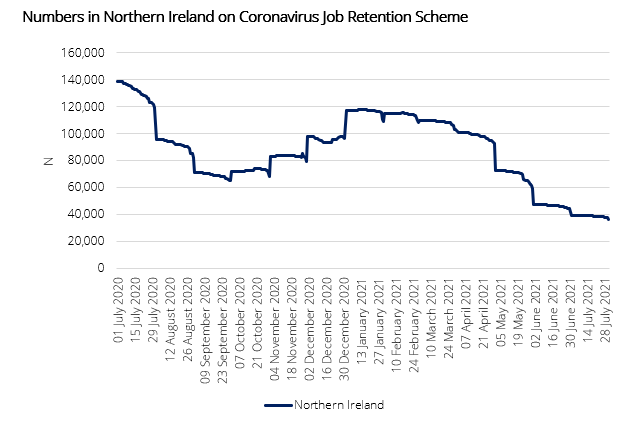
In terms of reasoning for this conclusion we need to bring into consideration the changes in the CRJS which came into play at the start of July 2021, which marked the first change in the generosity of the scheme since April 2021. In the months April, May and June 2021 employers were only required to contribute employers NIC and pensions. From 1st July 2021, the Government introduced an employer contribution towards the cost of unworked hours of 10 percent in July 2021. This contribution is in addition to the contribution already required for employers NICs and pensions. For the month of July 2021, CJRS grants cover 70 percent of employees' usual wages for the hours not worked, up to a cap of £2,187.50. Employers need to pay the 10 percent difference in July 2021 so that they can continue to pay their furloughed employees at least 80 percent of their usual wages for the hours they do not work during this time, up to a cap of £2,500 per month.
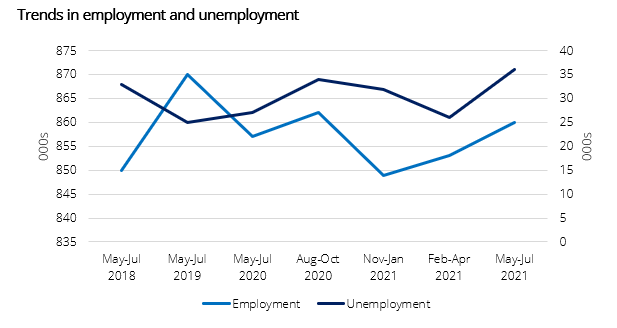
At the same time, we also need to bring into consideration changes in the numbers in employment and numbers in unemployment over the course of the year. In doing so, what becomes clear is that as the generosity of the furlough scheme started to lessen from April 2021 we have begun to see a relatively stark increase in the rate of unemployment. This is notwithstanding an increase in the numbers in employment, which have continued to increase over the course of the year as the economy continued to adjust to the ongoing nature of the Covid-19 crisis and the economy gradually reopened.
It is in seeing how changes in the CJRS have impacted on the numbers availing of the scheme and how these have subsequently impacted upon trends in employment and unemployment that it seems unlikely that as the CJRS is entirely removed at the end of this month that we will not see a continuing sharp relative increase in unemployment. The sharpness of the recent quarterly increase in unemployment given the relatively modest decline in the generosity of the scheme would further attest to this theory.
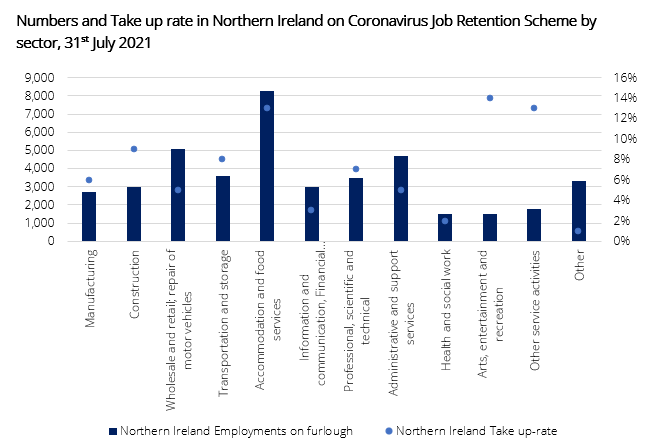
Furthermore, an examination of a sectoral breakdown of the numbers remaining on the CJRS at the end of July lends further support to this prediction. As detailed in the chart below we see that the majority the ‘Wholesale and retail’, ‘Accommodation & Food services’, ‘Construction’ and ‘Manufacturing’ sectors comprise a majority of those continuing to avail of the furlough scheme as of July 31st. This finding is anomalous given that these sectors of the economy have been reopened for some time now. Of course, part of this is compositional given that these are sectors which employ large proportions of our workforce, however this does not explain the entire story with for example more than 1 in 10 of the ‘Accommodation and Food services’ sector and almost 1 in 10 of the ‘Construction’ sector availing of the furlough scheme on the 31st July. Some might say that not all sectors of the ‘Accommodation and Food services’ sector have reopened, such as for example, nightclubs, and so this might explain the continuing high number from this sector availing of furlough. However, with no indicative date for the reopening of nightclubs and a definitive date for the ending of the CJRS it is hard to fathom how the ending of the scheme will not perpetuate into unemployment for such workers. Moreover, it is somewhat perplexing that some 1500 workers from the health and social work sector remained on the furlough scheme at the end of July and it is difficult to surmise how the end of the CJRS will mean a return to work for these workers, if it has not done so already.
What is outlined above in terms of the likely upward trajectory of unemployment over the course of the coming months is of course a prediction. And indeed, it is a prediction which looks overly pessimistic if we look at the claimant count and proposed redundancy figures which we have more timely data. However, it is not thought that in this instance that either of these data sources are so timely that they would give us an indication of what is going to happen when the CJRS ends at the end of September. The most recent claimant count data only covers up until 12th August, whilst the proposed redundancy figures cover only to the end of August. Moreover, given that only proposed redundancies of more than 20 employees are legally obliged to be reported it is unlikely that these data will colour the picture in greater detail as more data becomes available before the next raft of labour market statistics.
What happens when the increase to Universal Credit is withdrawn?
While the announcement last week of an increase in national insurance garnered much media attention, the proposed cut to Universal Credit is likely to have an even bigger and more immediate impact on household income and living standards. The narrative coming from the UK government is that as the economy begins to recover and more and more people return to work, the uplift in benefits is no longer necessary. This represents a fundamental misunderstanding of what Universal Credit is.
Universal credit is a benefit paid to people both in and out of work. As a payment to those unemployed, Universal Credit is the least generous out of work payment of any advanced western economy. Before the £20 uplift Universal Credit provided wage replacement of just 12% of the average wage, the lowest of all OECD economies. Even with the uplift, the replacement rate only increased to 17%, well the OECD average of 55%. The idea that unemployment benefits paid by Universal Credit are a disincentive to work is somewhat farfetched.
Another underappreciated fact about Universal Credit is that it is a paid mostly to people in working households. In 2019/20 in Northern Ireland there were approximately 113,000 recipients of Universal Credit. Of that total only 38% were in workless households. 31% of recipients were in a household with at least one working adult, and a further 31% were in households where all adults work.
Universal Credit is an umbrella benefit through which a number of payments, including Job Seeker’s Allowance, are paid. The whole purpose of Universal Credit was that as people transitioned from unemployment to work, they would retain some transitional benefits to ensure no cliff edge in support. In practice, Universal Credit has been underfunded from its inception and this has prevented it from achieving its central purpose. Removing the £20 uplift will deal a significant blow to household incomes for no good reason. All it shows is that the government never understood Universal Credit and that the experience of the pandemic has done nothing to change that.