


‘In essence, rather than reflect a unique ‘attitudinal problem’ among certain sections of Irish society, Ireland’s high rate of adults in low work intensity households actually reflects a structural issue that discriminates against mothers and the disabled.
One that could be addressed by policymakers by developing the Irish welfare state to foster a more inclusive labour market (affordable childcare in particular), which would in turn help to bring down excessive Irish market income inequality.’
Ireland’s extreme market income inequality is a story of an underdeveloped welfare state that reproduces barriers to the labour market faced by mothers (and the disabled).
Ireland has one of the most unequal distributions of household market income inequality in the developed world. Depending on the indicator, we’re either at the top (GINI coefficient) or an outright outlier (no other country in Europe comes close to Ireland in its disparity between the share of market income going to the top 20 percent and the bottom 20).
This is rarely discussed.
The dominant explanation is that Ireland has a high share of jobless households (a higher share of households with zero market income). Other than for a few years at the height of the financial crisis, this was never particularly true. Greece, Italy, France and Belgium all have lower GINI coefficients and less disparity in the share of market income going to the top and bottom fifths and all have higher shares of adults in jobless households (the indicator excludes households made up entirely of students). In 2007, France had over 30 percent more adults in jobless households per capita than Ireland. In 2019 and 2020, Sweden had too.
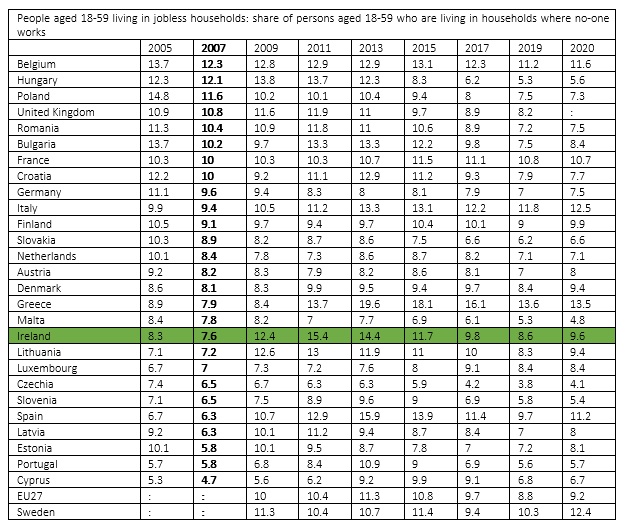
This narrative seems to have taken off around 2012/2013 in response to an unemployment rate that kept climbing despite four or five austerity budgets designed to regain the ‘confidence’ of investors after the financial crisis and bank bailout and return us to employment growth. This happened notwithstanding the mass migration of hundreds of thousands of young people to the US, UK, Australia and Canada (who I’ll add, left looking for work). The term ‘jobless households’ was used specifically in Troika progress reports on the conditions attached to financing the bank bailout to explain persistent underperformance in the Irish economy. The issue would be tackled by attacking jobseekers’ benefits and attaching conditionality and penalties (cutting support payments for instance) in relation to searching for and taking up employment (rather than actually protecting or creating employment).
Austerity was the only game in town and the only way back to sustainable growth (so we were told). Recently, many if not most of the international institutions driving these policies have moved on, some have even admitted austerity was a mistake (including the European Commission).
Pointing the finger at jobless households was a convenient narrative to shift the blame away from failing austerity policies pushed by successive Irish governments and imposed across the Eurozone to a group of people who are relatively voiceless in Irish society. Over half of the adults in jobless households in 2012 had not lived in jobless households before the collapse in construction in 2008 and the following contraction in some demand led, low wage sectors (retail in particular).
The underlying message here is clear and nakedly classist.
It’s not successive Irish governments at fault. It’s not our technocratic expert management either. It’s not that the research paper (Reinhart and Rogoff) on which the legitimacy of this entire austerity rested turned out to be wrong due to a human error in Excel. It’s not deficit hawkery or ideology or German fears of inflation. It’s lazy sponges who are to blame. Even when it was the banks most of our most gifted policy analysts knew it was the involuntarily unemployed all along. There was a column in the Sunday Times only a few weeks ago on inequality that literally referred to ‘these people’ in jobless households.
The Irish establishment seems to believe wholeheartedly that we have a higher share of people who need an attitude adjustment than in other high-income countries and really, they are the ones dragging us down in international rankings on various indicators related to living standards.
This kind of messaging sets the stage for cutting jobseekers for under 25’s in half (it is still just over €100 euro a week). It justified introducing a ‘stick’ approach to jobseekers in a labour market with some of the lowest job vacancies in Europe and over thirty applicants for every job opening. It also sets the stage for ugly campaigns against jobseekers with spurious claims about widespread welfare fraud and it’s cost to the state. It’s all part of the political economy to maintain low wages in the domestic economy.
Recently the explanation has developed to a high share of ‘very low work intensity’ households (households with zero or very low market income) are to blame for Irish household market income inequality. It’s not quite the same as jobless households (all jobless households are also low work intensity), but related and the underlying message is the same and clear: this is an attitudinal problem among certain sections of Irish society and they are a drag on the economy.
‘….persons living in households with very low work intensity is defined as the number of persons living in a household where the members of working age worked a working time equal or less than 20% of their total work-time potential during the previous year. Households composed only of children, of students aged less than 25 and/or people aged 65 or more are excluded from the indicator calculation.’
On this particular indicator, we do have a relatively high rate. Approximately, 13 percent of Irish adults live in a low work intensity household. We’re right behind Greece and in effect, equal to the rate in Belgium. So, low work intensity likely explains some of Ireland’s high level of inequality.
Evidence from the Survey on Income and Living Conditions shows Ireland is an outlier in a high-income European context (often just in a European context) in the likeliness of being in a low work intensity household for two specific groups.[1] This evidence is supported by data showing similar trends in employment and labour market participation in the Labour Force Survey.
- 13.1 percent of Irish adults (18-59) live in very low work intensity households, the third highest in the EU behind Greece (15.8 percent) and Belgium (13.2 percent). For women, it’s 14.7 percent, the 2nd highest rate.
- 350,000 are adults (200,000 females, 150,000 males), up 25,000 on 2018. 185,000 are children.
- In 2006, there were 287,000 adults, doubling by 2011 to 650,000.
- The share of males of prime working age (25-54) in very low work intensity households is only slightly above the Eurozone average (9.7 vs 8.5 percent).
- However, 12.6 percent of females in the same age group live in low work intensity households, the 2nd highest in the EU and 42% above the Eurozone average (8.6 percent).
- 42.2 percent of single parents (mothers mostly) are in a very low work intensity household. Though single adults with dependents make up just 4 percent of the adult population, this is the highest rate in the EU by a country mile (more than a third higher than second place, the Netherlands at 30%). The rate is over twice the EU average.
- In fact, 13.3 percent of all adults in households with dependent children are in very low work intensity households, over twice the EU average (6.4 percent) and three times the rate in Germany (4.5 percent).
- Ireland is an outlier when it comes to the share of women aged 35-44 in households with low intensity work rates. At 11.7 percent it is almost twice the EU average (6.0 percent) and well ahead of even Greece. This is over twice the share in Germany, Denmark, Finland, Romania and Poland and over three times the share in Portugal. If the share of women in low work intensity households in this age group alone fell to the EU average in Ireland, we’d have an additional 23,000 women (about 1 percent of employment) more fully engaged with the labour market.
- 7.2 percent of Irish women between 35 and 44 have a secondary education or below (levels 0-2) and this group are most likely, not just in the EU, but out of 36 European countries to be in a low work intensity household (58.6 percent). Ireland is a clear outlier on this measure too. The next closest EU member has just over half the share (32.6 percent) and it’s 3.4 times the EU average.
- Irish women in the middle bracket of educational attainment [upper secondary and post-secondary non-tertiary education (levels 3&4)] between the age of 35 and 44 are also most likely in Europe to be in a low work intensity household (14.4 percent), two and a half times the EU average (5.9 percent).
- Even at the highest level of education (tertiary 5-8) this is a highly gendered issue in Ireland. Sixty-one percent of Irish women in this age group are in this bracket. Highly educated men aged 35-44 in Ireland are half as likely to be in a low work intensity household as the Eurozone average (1.5 percent v 3.0 percent) while women are 4th most likely in the EU and three times more likely than Irish men of the same age and education (4.4 percent).
- For both the middle and top educational groups in the entire Eurozone, there is little gender difference in the likeliness of being in a low work intensity household in prime working age (25-54). 4.4 v 4.6 percent for the top group, 8.0 v 8.0 percent for the middle group.
Interestingly, the share of people under 60, living in households with low work intensity but also own their house outright (no mortgage) is very similar to the national share (12.1 percent compared to 13.6 percent). This is also over 40 percent higher than the EU average for the same group (8.6 percent). In the case of this group, low work intensity might actually reflect affluence (passive income even) and no need to work due to the financial security of homeownership.
Further evidence from the Labour Force Survey on employment and inactivity rates also points to a highly gendered component in explaining low work intensity rates in Ireland and by extension Irish market income inequality.
Employment
- A single mother with a tertiary education between 20 and 49 years of age in Ireland is less likely to be in employment than in any other EU county (75.4 percent in 2020 compared to Portugal (95.4 percent) and Germany (90.4 percent).
- Even with a partner, highly educated women with dependent children (20-49) in Ireland are less likely to be in employment in a European context (79.5 percent compared to an EU average of 84.2 percent and high performers like Belgium and the Netherlands on 89.5 and 90.3 percent)
- For all adult women with children, the employment rate is 67 percent, lower than Poland (67.5 percent) and way behind Germany (77.5 percent) and Sweden (82.8 percent).
Inactivity (not only not in employment, but not seeking employment)
- Of the 914,000 working age ‘inactive’ in Ireland in 2020, 555,000 are female (roughly 40/60 split).
- 297,000 are 25-49 (212,000 females, 85,000 males).
- 43.5% of inactive females in the same age group (92,000) are economically inactive because they are looking after kids or disabled relatives (the vast majority is related to childminding). This is among the highest rates in Europe and well above the Eurozone average (24.0 percent). If Ireland had the average rate of this group, female employment would increase by approximately 3-4 percent.
- The activity rate for all Irish women is just under the EU average but rates are particularly low between 30 and 49 (4th lowest for 35-39, 40-44 and 45-49 years).
What this high share of low work intensity households but not so high share of jobless households reflects in large part is the interaction between excessive Irish childcare costs and a high share of low wage and precarious employment, especially for women. This mismatch ultimately prevents higher shares of Irish mothers from fully engaging with the labour market than the norm in developed economies.
- Ireland has one of the highest shares of low wage employment in Europe, but it’s higher for women (22.6 compared to 16.6 percent). In a high-income EU context only Germany has a higher share, yet their employment rate for women of working age is over 8 points higher (73.1 compared to 64.8 percent).
- Half (49 percent) of all female part-time workers from 25-54 are in the highest education bracket (88,000), over twice the share as in 2004 (22.9 percent or 41,000) and almost 50 percent higher than the EU average (34.7 percent).
- 30.6 percent of female workers work part-time in Ireland and almost half (44.9 percent) of all part-time female workers 25-49 work part-time due to childcare/dependent adult responsibilities (4th highest in the EU). In 2008, it was only 31 percent.
- 30.2 percent of the same group would work more hours if they could (own calculations, LFS AMF). Almost half of temporary workers in this same group (48.8 percent) are involuntarily on fixed term contracts (own calculations, LFS AMF).
Besides mothers, Ireland is also an outlier in terms of the share of disabled in work (1 in 5 economically inactive adults are disabled (20.2 percent) compared to an EU average of 12.3 percent).
A recent OECD report described the Irish labour market as ‘not very inclusive’ and alluded specifically to underperformance in creating an environment where people with disabilities can engage with the labour market and escape low income and poverty:
‘In 2016 (census data), the employment rate of persons with disabilities was about half of the rate for persons without disabilities (36.5% vs. 72.8%). This employment gap is much larger than in most other EU-OECD countries, and also slightly larger than the gap in Ireland ten years earlier.’ ‘The exceptionally high unemployment rate for persons with disabilities in Ireland, of almost 30% compared to about 10% for the rest of the population, prior to the pandemic and the resulting jobs crisis, mirrors their struggle to find employment.’
Eurostat estimate the employment gap to be even higher, at 44 points in Ireland, the highest in the EU in 2019 and up on 2014 (39.8 pp’s). With 331,000 people with a disability of working age (20-64) in 2016, if Ireland were to close the employment gap to the European average it would translate to an additional 50,000+ people with disabilities in work (that translates to about 2-3 percent of Irish employment).
In essence, rather than reflect a unique ‘attitudinal problem’ among certain sections of Irish society, Ireland’s high rate of adults in low work intensity households actually reflects a structural issue that discriminates against mothers and the disabled.
One that could be addressed by policymakers by developing the Irish welfare state to foster a more inclusive labour market (affordable childcare in particular), which would in turn help to bring down excessive Irish market income inequality.
[1] (data 2019: ilc_lvhl11, ilc_lvhl12, ilc_lvhl13, ilc_lvhl14, ilc_lvhl17)