
In this blog by Dr. Nat O'Connor, Lecturer/Assistant Professor in Social Policy at UCD he presents on his report 'Ireland's Public Spending Explained 2024'.
Find his presentation and video from the NERI seminar that took place on Wednesday 4 September 2024.
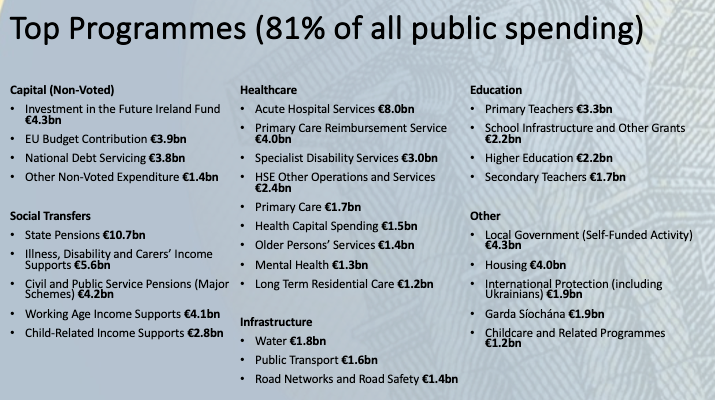
Ireland’s Public Spending Explained 2024 describes how over €114 billion was allocated in public spending this year. The report breaks this down into 105 ‘spending programmes’. There are 30 ‘top’ programmes (see image), each of which costs at least 1% of all public spending. Collectively, these account for 81% of allocations, which clarifies where most government effort is going; €10.7 billion to pay state pensions; €8.0 billion for acute hospital services; €1.8 billion for water services; and so on. Unsurprisingly, healthcare, social transfers and education are all big areas of spending. But the purpose of focusing on spending programmes is to move away from these vague categories like “health spending” and to get into more specific programmes that are still high level, but which are more tangible, such as the €1.3 billion spent on mental health services or the €3 billion spent on specialist disability services.
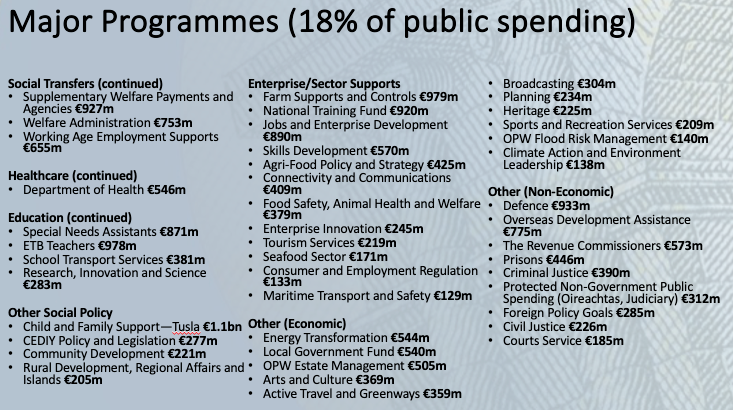
Next are the ‘major’ spending programmes, which cost less than 1% but more than 0.1% of public spending. They make up another 19% of allocations, and combined with the top programmes they sum up to 99% of all public spending. A lot of these are economic programmes, supporting sectors of the economy or specific industries, like farming, seafood or tourism, or else providing generic supports like skills development or enterprise innovation. Fundamental parts of the state like defence, the Revenue Commissioners and the courts are also included in these programmes.
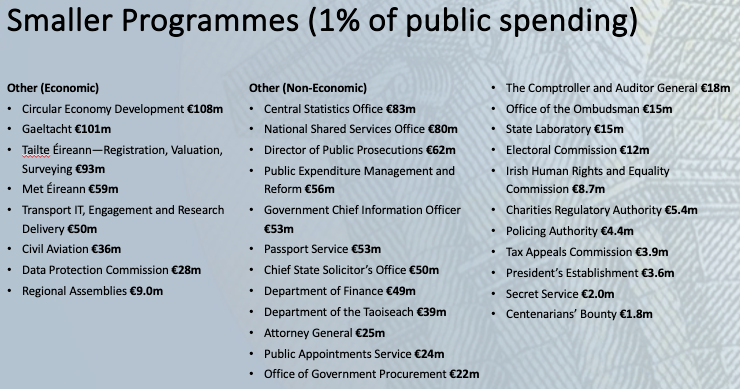
Finally, Ireland has 31 ‘smaller’ spending programmes. Despite only accounting for 1% of public spending, this includes whole government departments, major public agencies, and spending that is strategically or culturally important for Ireland. For example, the Departments of Finance, Public Expenditure and Taoiseach each constitute a smaller spending programme, as does Met Éireann, the Director of Public Prosecutions and the Ombudsman’s office.
The sole recommendation that I made during my NERI seminar was for Ireland to develop an agreed set of spending programmes, as a step towards a more better informed national conversation on public spending. I don’t claim to have got it right in the report, but it is hopefully a step in the right direction.
It is very frustrating to have the national budget process presented in the media as “how will it affect money in your pocket” as if the only thing that matters is tax cuts and changes to social welfare rates. There is never much analysis of the many services that are received in exchange for our tax payments. And there is certainly a lack of mature debate about what public services people want, and how much we are willing to pay for them.
It is also clear from the report that Ireland does not have unlimited scope to raise taxes to improve and expand public services. We already spend close to the average per capita spend of European OECD members, and a large part of the difference between Ireland and higher-spending North West European countries is due to their older populations (higher pension and healthcare spending) and defence spending. While we could and should strengthen the tax base, we also need to do more to scrutinise public spending to make sure we are getting value for money. The public won’t agree to higher taxes unless they are convinced that the state can deliver, and with scandals from the National Children’s Hospital through to the extraordinarily expensive bike shelter at Leinster House, work is needed to restore public confidence.
The next step would be for the Departments of Finance and Public Expenditure to agree a standard set of spending programmes. As outlined in the report’s method section, we are halfway there with the breakdown of departmental spending provided by the Department of Public Expenditure’s online databank. For example, the Department of Housing, Local Government and Heritage is subdivided into six coherent spending programmes: Housing; Water and Marine; Local Government; Planning; Met Éireann; and Heritage. However, not all departments’ spending can be so neatly divided up and a lot of work is needed to clarify Health/HSE spending in particular. But it would be well worth doing if we could have a better national conversation about public services—and how we are going to fund the public services that many people say they aspire to in Ireland, such as universal healthcare and more robust social protection.
Nat O’Connor is Lecturer/Assistant Professor in Social Policy at UCD. He is also Policy Adviser to Age Action, and previously worked in the Homeless Agency, TASC, Ulster University, Maynooth University and the Labour Party. Nat has an MA from Dundee University and a PhD from Trinity College Dublin. He is chairperson of the Irish Social Policy Association (www.ispa.ie) and a member of the National Economic and Social Council (NESC).