


  • X
  • Facebook
  • YouTube

Top header menu

  • Sign up to our mailing list
Home
  • Themes
      1. A New Economic Model
      2. Wages and Incomes
      3. Employment and Job Quality
      4. Climate and the Just Transition
      5. Taxes and the Welfare State
      6. Understanding the Labour Market
  • Our Work
      1. Research
      2. Blog
      3. The NERI videos series
      4. Learning about our economy
      5. Media
      6. Visualising our economy
  • Dashboards
      1. Broad sectors
      2. Subsectors
  • Events
      1. External event contributions
  • About
      1. Our team
      2. Our supporters
      3. Charities Governance Code
  • Contact

Topics

  • A New Economic Model
  • Wages and Incomes
  • Employment and Job Quality
  • Climate and the Just Transition
  • Taxes and the Welfare State
  • Understanding our Labour Market

Invest windfall taxes at home rather than abroad: The Future Ireland Fund will do little to reduce ageing costs

cranes
Blog
 October 
24,
 2023
Profile picture for user Rory O'Farrell
  By Rory O'Farrell

Blog written by Dr. Rory O'Farrell, an economics lecturer at TU Dublin discussing the Future Ireland Fund put forward in Budget 2024.

One of the measures put forward in Budget 2024 is the establishment of a €100 billion Future Ireland Fund to pay for ageing costs from 2040 onward. However, despite large sacrifices, this will have little effect.

Ageing costs, such as pensions and medical care, are expected to rise from just under a quarter of GNI* (the modified measure of national income which removes profits of foreign multinationals) to almost a third by 2070 (Figure below). Such costs can be dealt with by saving money in advance, or by directly reducing the costs (such as by raising the pension age).

The government’s plan is to front-load ageing costs by creating the Future Ireland Fund. It is planned that the fund will be seeded with funds from the National Reserve Fund (NRF), and each year the equivalent of 1.5% GNI* (0.8% of GDP) will be saved until 2035. This money will not be invested in Ireland, but abroad. It is anticipated that a fund of €100 billion would be accumulated, and the returns from this fund would be drawn down from 2040 onwards.
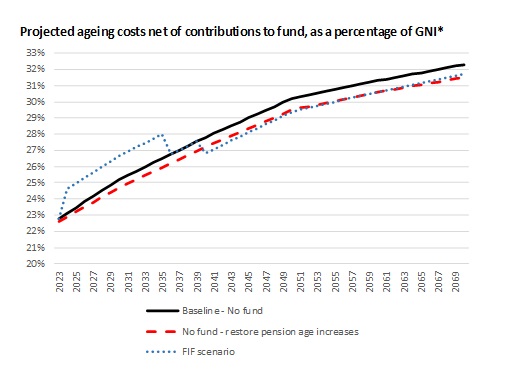
Projected aging costs net of contributions to fund, as a percentage of GNI*

Despite the high upfront costs, the benefits of the fund will be relatively small. As shown in the above figure, setting aside 1.5% of GNI* over the next decade will only reduce ageing costs by 1% in 2040, falling to 0.6% by 2070. This small impact is because the economy is expected to grow over the next decades: effectively Ireland will be saving while we are relatively poor to spend when we are relatively richer. Restoring the pension age increases abandoned in 2022 would have a similar effect on ageing costs, but without the upfront pain.

Instead of creating a fund that invests abroad, the government should use windfall corporation tax receipts to create a fund that will invest in infrastructure in Ireland. Such a fund has been proposed by groups such as NERI and IBEC, and there is a consensus that windfall taxes should not be spent immediately. 

An infrastructure fund would have two main benefits. Firstly, it would ensure secure funding of infrastructure and prevent the boom-bust pattern following the Global Financial Crisis. Secondly, and more importantly, it would allow expertise to be retained within a single infrastructure procurement agency. It is inevitable that errors are made in procurement (such as with the National Children’s Hospital). However, at present what is learned from such mistakes is not retained.

Ireland now has an opportunity, not just to build infrastructure, but also to build on the experience gained from previous projects.
 

Profile picture for user Rory O'Farrell

Rory O'Farrell

Dr Rory O’Farrell, former NERI Economist and is now lecturing in economics at Technology University Dublin.

Upcoming events

Wed, Sep 16 2026, 3:30 - 4:30pm
The Irish labour market: Recent developments and future growth
Online Zoom event
Thu, Oct 8 2026, 3:30 - 4:30pm
The Budget 2027: NERI Post Budget Analysis
Online Zoom event
Wed, Nov 11 2026, 3:30 - 4:30pm
European Attitudes to Basic Income: exploring women's perspectives
Online Zoom event

Latest

It’s wrong to assume that job quality is the enemy of job creation
job quality
A number of business organisations recently wrote to the Economy Minister...
New Labour Market Entrants, earnings, housing costs and living standards in 2024
Man and savings
This Research InBrief by NERI economist, Ciarán Nugent examines trends in...
Progress in Pay, But Not in Participation or Progression
money
Some of the results move in the right direction, but overall the picture is one...

Breadcrumb

  1. Home
  2. Blog
  3. Invest windfall taxes at home rather than abroad: The Future Ireland Fund will do little to reduce ageing costs

Subscribe to our Mailing list

  • X
  • Facebook
  • YouTube
Logo

The Nevin Economic Research Institute is a Registered Charity since the 1 August 2013 with the Charity Number - 20082130.

Privacy and Cookies

We use necessary cookies to make our site work. We also use analytics cookies without user tracking to help us improve our site.

Cookie Policy | Privacy Statement

Website design and development by Infobo.

Contact us

  •  Address: 31/32 Parnell Square, Dublin 1, Ireland
  •  Telephone: +353 1 8897722
  •  Email: [email protected]
  •  Address: 45-47 Donegall Street, Belfast BT1 2FG
  •  Telephone: +44 28 902 46214
  •  Email: [email protected]
Copyright © 2025 Nevin Economic Research Institute. All rights reserved.

Footer

  • Contact
  • Privacy
  • Cookie policy
  • Themes
    • A New Economic Model
    • Wages and Incomes
    • Employment and Job Quality
    • Climate and the Just Transition
    • Taxes and the Welfare State
    • Understanding the Labour Market
  • Our Work
    • Research
    • Blog
    • The NERI videos series
    • Learning about our economy
    • Media
    • Visualising our economy
  • Dashboards
    • Broad sectors
    • Subsectors
  • Events
    • External event contributions
  • About
    • Our team
    • Our supporters
    • Charities Governance Code
  • Contact
Clear keys input element