


In this blog, NERI Co-director Paul Mac Flynn discusses the findings of a report into the state of the NHS in England.
Last week the new Labour government released the findings of a report into the state of the NHS in England. To say that the headlines were bleak would be something of an understatement, but this kind of analysis can also be a catharsis of a sort.
At almost every budget or fiscal event over the last 14 years, we heard about how the government was spending record amounts and ‘protecting the NHS’. For anyone who actually had to engage with the service, these claims were often mystifying, if not insulting. How could we be spending more and more on the NHS and end up with a service that was crumbling before our eyes?
The report, drawn up by Labour peer and former NHS surgeon Lord Darzi sets out the problem with honesty and nuance. Firstly, the NHS has been underfunded. Despite above inflation increases in funding, the demand on health services has grown significantly over the last number of years.
The increase in demand for healthcare didn’t come out of nowhere. The report attributes the increase in poor health and various conditions to underfunding in other areas of public expenditure like housing and welfare. The previous government may have prioritised funding the NHS, but it was a false economy because by taking the money from other areas of expenditure they simply increased the overall demand for health.
So, yes, the NHS was underfunded, but it was also underfunded in a more specific and insidious way. Funding for all public services is divided between Resource and Capital spending. Resource spending, or current spending, is used to fund day to day expenses like wages, utility costs and supplies. That is what we normally think of when we discuss NHS funding because it’s the money that literally keeps the lights on and the doors open. But capital expenditure is just as important.
Capital expenditure is money that is used for investment. It is one-off spending, in that it is used to build or buy something rather than committing to something on a long-term basis. We use capital expenditure to build hospitals, to purchase machines like scanners and computer systems. What the Darzi report highlights is the lack of investment in our NHS over the last number of years and its relationship to the state of the NHS now.
The fact is that capital expenditure in health decreased significantly over the 10 years from 2010 to 2020. That is in cash terms so when we take inflation into account, the amount of money going into investment in our health service actually fell. The Darzi report estimated that the NHS lost out on £37bn worth of investment that it would have received if capital funding had matched our peer countries. The impact of this has been one of the more underappreciated elements of our current predicament.
The absence of investment in the health service isn’t just bad because we lose out on shiny new buildings or fancy machines. The lack of investment plays a direct role in undermining the delivery of health services. Not investing in infrastructure means that transformation of services isn’t possible.
The Darzi report makes clear that the shortfall in capital funding meant that all the increases in current funding over the last few years did not find their full effect. Without the investment in equipment and technology, productivity falls and the effect of increases in staffing are wiped out. To compound this problem, funding was switched from capital to current in order to plug holes in day-to-day funding, further entrenching this self-destructive spiral.
Looking at our own experience of the NHS in Northern Ireland, we can identify many of these aspects. As far back as 2011, we made provision in the Northern Ireland budget for the Health Department to switch capital spending into current spending. Capital spending on Health in NI was £210m in 2009 and by 2019, the eve of the covid pandemic, that had only risen to £215m. When we adjust for inflation, that is actually a decrease of almost £40m in real terms.
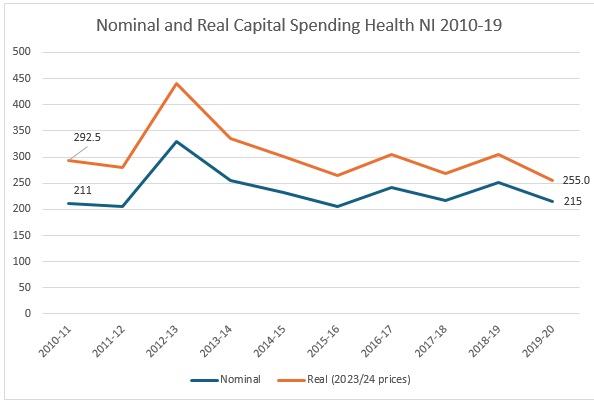
The increases in the years that followed are mostly accounted for by covid spending, but even if we were to bring spending levels back up to 2010 levels in real terms, it would not be enough. That is because every year of underspend counts as a loss and all those losses add up. Even if health budgets were brought back to 2010 levels this year, that doesn’t make up for 10 years without modern scanners or diagnostic equipment.
But health isn’t the only areas where we let investment falter. Total capital expenditure in NI in 2024 is unchanged in real terms from where it was in 2009. But once again, it is the cuts in the years in between that are most important. Capital spending fell considerably after 2010 and had decreased by almost 50% in 2015 before slowly climbing back up again. Taken together, all the cuts to capital spending since 2010 amount to £3.1bn of lost public investment.
The deal to restore the NI Executive earlier this year contained a commitment to transform public services. That is a necessary task and anyone who cares about the future of public services will want to see it implemented. But real transformation requires investment and, on that front, we are not even at the races.