
  • X
  • Facebook
  • YouTube

Top header menu

  • Sign up to our mailing list
Home
  • Themes
      1. A New Economic Model
      2. Wages and Incomes
      3. Employment and Job Quality
      4. Climate and the Just Transition
      5. Taxes and the Welfare State
      6. Understanding the Labour Market
  • Our Work
      1. Research
      2. Blog
      3. The NERI videos series
      4. Learning about our economy
      5. Media
      6. Visualising our economy
  • Dashboards
      1. Broad sectors
      2. Subsectors
  • Events
      1. External event contributions
  • About
      1. Our team
      2. Our supporters
      3. Charities Governance Code
  • Contact

Topics

  • A New Economic Model
  • Wages and Incomes
  • Employment and Job Quality
  • Climate and the Just Transition
  • Taxes and the Welfare State
  • Understanding our Labour Market

Coronavirus and Northern Ireland: Initial Indications

Coronavirus
Blog
 June 
22,
 2020
Profile picture for user Paul Mac Flynn
  By Paul Mac Flynn

As we continue to monitor and analyse the impact of the coronavirus in Northern Ireland more and more data is coming to light that helps us to fill in the gaps in our knowledge.

Earlier this month, we got the first official estimates for Northern Ireland of the uptake of the UK government schemes that were put in place back in March.

Figures from Her Majesty’s Revenue and Customs reveal that just over 211,000 people in Northern Ireland were furloughed under the Coronavirus Job Retention Scheme. If we take the number of furloughed employees as a percentage of the total number of employees before the onset of the pandemic, we can show in the table below that NI had the second highest percentage of employees in the scheme of any UK region. This is somewhat surprising given that the scheme does not apply to public employees and NI has among the highest share of public employees of any region.

1

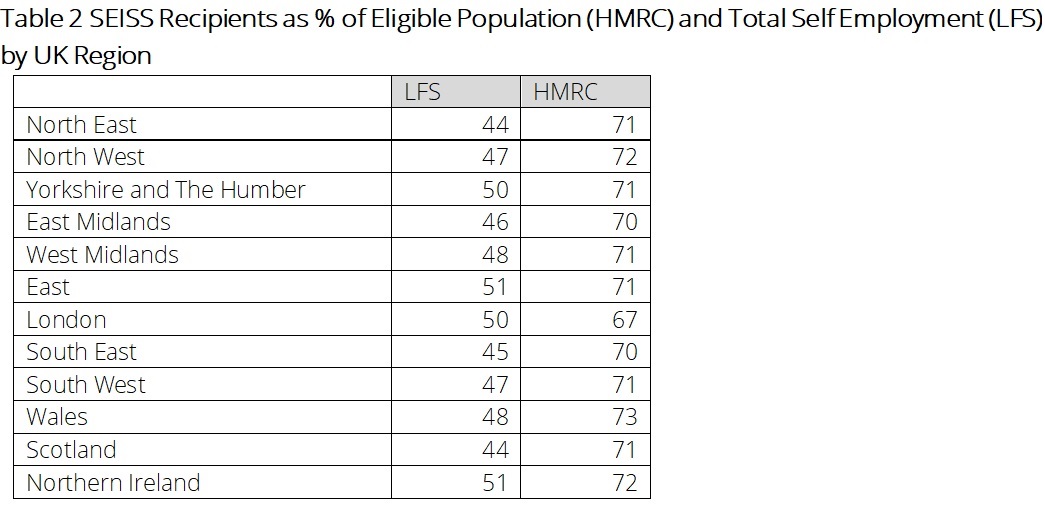
Northern Ireland also has one of the highest take-up rates for the Self Employment Income Support Scheme. HMRC provided regional estimates of how many self-employed people would be eligible to claim SEISS. As there is no explanation for how eligible population estimates are arrived, the table below also shows the number of claimants as a percentage of the number of those self-employed in each region according to the latest Labour Force Survey. By either measure, NI has either the highest or the second highest proportion of claims of any UK region.
2

These figures have good points and bad points. On the positive side, government assistance has helped a higher proportion of people in NI than any other region. Given the explosion in unemployment that would have taken place in the absence of these schemes, this is welcome. On the less positive side, it shows the mountain that NI will have to climb on exiting the lockdown phases of this pandemic. It also shows that any early closure or curtailment of these schemes could hit NI very hard.

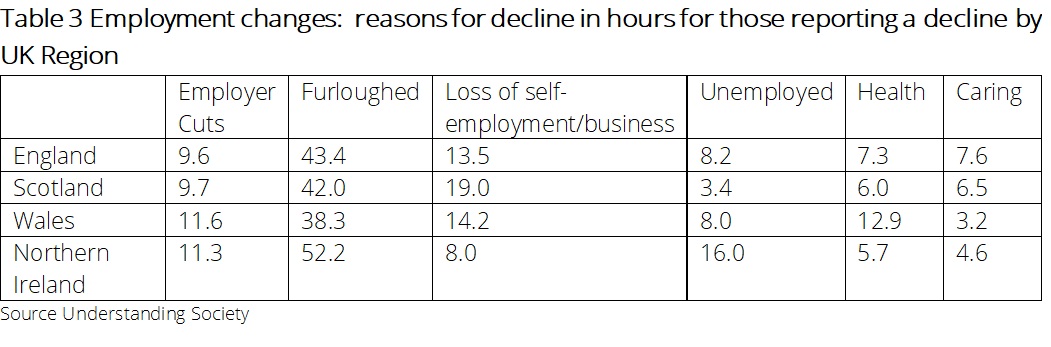
There was more data released earlier this month from the Understanding Society survey which has run special modules to assess the impact of the coronavirus in the UK. Looking at those who reported a fall in working hours, similar to the HMRC data, NI had the highest proportion of those losing hours due to furlough, but more worryingly, NI also had the highest percentage of those losing hours due to unemployment, double that of England and Wales.
3

Looking at earnings, the Understanding Society data shows Northern Ireland and England have seen the largest declines. For those who have seen a 5% and a 20% decline in earnings, NI and England report higher percentages than either Wales or Scotland.
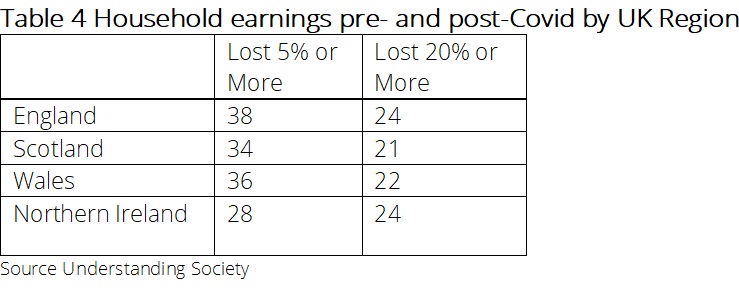
4

In terms of how people have coped with lost income, the data show that people have dipped into saving, spent less or used help like mortgage holidays. NI reported a far greater number of people using Universal Credit to make up for losses. However, NI also reported a far greater number of people making up for lost earnings by getting new work. Looking at household finances, NI reported the highest proportion of people who expect their financial situation to be worse off next month.
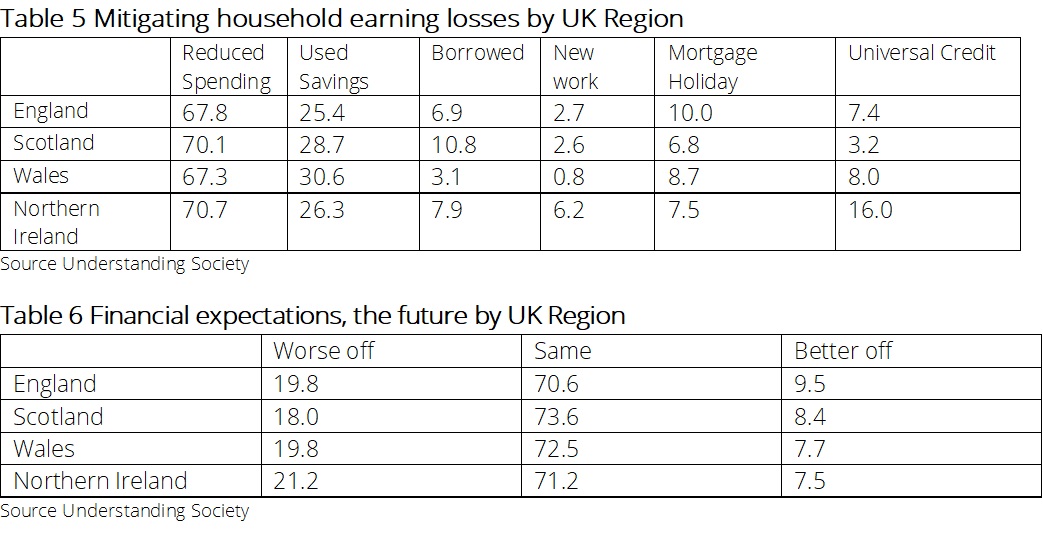
5

All of this data helps us to get some kind of picture of exactly what kind of economic crisis we are in the middle of. At this stage the scale of the policy response that will be required to exit the current lockdown phase certainly looks to be of a different order to anything that has gone before.


Profile picture for user Paul Mac Flynn

Paul Mac Flynn

Paul Mac Flynn is co-director of the Nevin Economic Research Institute and is based in the Belfast office. In addition to managing the Belfast office he has co-responsibility for the NERI's research programme and for its strategic direction.  

He leads on the NERI’s analysis of the Northern Ireland economy along with all research into the impact of the United Kingdom‘s departure from the European Union. Other research areas include regional productivity, the all-island economy and the future of work.

He is a graduate of University College Dublin with a BA in Economics and Politics and the University of Bristol with an MSc in Economics and Public Policy, specialising in the economic impacts of political devolution in the UK.

Contact: [email protected] or 00 44 28 9024 6214.

Upcoming events

Wed, Sep 16 2026, 3:30 - 4:30pm
The Irish labour market: Recent developments and future growth
Online Zoom event
Thu, Oct 8 2026, 3:30 - 4:30pm
The Budget 2027: NERI Post Budget Analysis
Online Zoom event
Wed, Nov 11 2026, 3:30 - 4:30pm
European Attitudes to Basic Income: exploring women's perspectives
Online Zoom event

Latest

It’s wrong to assume that job quality is the enemy of job creation
job quality
A number of business organisations recently wrote to the Economy Minister...
New Labour Market Entrants, earnings, housing costs and living standards in 2024
Man and savings
This Research InBrief by NERI economist, Ciarán Nugent examines trends in...
Progress in Pay, But Not in Participation or Progression
money
Some of the results move in the right direction, but overall the picture is one...

Breadcrumb

  1. Home
  2. Blog
  3. Coronavirus and Northern Ireland: Initial Indications

Subscribe to our Mailing list

  • X
  • Facebook
  • YouTube
Logo

The Nevin Economic Research Institute is a Registered Charity since the 1 August 2013 with the Charity Number - 20082130.

Privacy and Cookies

We use necessary cookies to make our site work. We also use analytics cookies without user tracking to help us improve our site.

Cookie Policy | Privacy Statement

Website design and development by Infobo.

Contact us

  •  Address: 31/32 Parnell Square, Dublin 1, Ireland
  •  Telephone: +353 1 8897722
  •  Email: [email protected]
  •  Address: 45-47 Donegall Street, Belfast BT1 2FG
  •  Telephone: +44 28 902 46214
  •  Email: [email protected]
Copyright © 2025 Nevin Economic Research Institute. All rights reserved.

Footer

  • Contact
  • Privacy
  • Cookie policy
  • Themes
    • A New Economic Model
    • Wages and Incomes
    • Employment and Job Quality
    • Climate and the Just Transition
    • Taxes and the Welfare State
    • Understanding the Labour Market
  • Our Work
    • Research
    • Blog
    • The NERI videos series
    • Learning about our economy
    • Media
    • Visualising our economy
  • Dashboards
    • Broad sectors
    • Subsectors
  • Events
    • External event contributions
  • About
    • Our team
    • Our supporters
    • Charities Governance Code
  • Contact
Clear keys input element