


In this weeks blog, NERI Co-director Paul Mac Flynn examines the Accommodation & Food Sector and why this sector is struggling to get staff after lockdown.
As the vaccine programme continues to roll out and the economy begins to open up again, there are some indications of significant shifts that have occurred over the period of lockdown. Whilst the furlough schemes and other financial supports were introduced to effectively freeze the economy in time, under the surface there have been changes that are now only coming to light. This has become particularly apparent in the hospitality sector with many businesses now struggling to get staff as they attempt to reopen and take advantage of pent-up demand in the economy.
Why is hospitality struggling to get staff? The root of this issue lies within the furlough scheme itself. While the furlough or Coronavirus Job Retention Scheme, allowed employers to keep on workers and enables them to pay them at least 80% of wages, these workers were at liberty to take up part-time work during their furlough period. Firms that were not shut down by the pandemic in many cases experienced a surge in business and required additional staff. From manufacturing to distribution and healthcare, these industries have provided some employment for many of the hospitality sectors workers over the lockdown period.
What appears to have happened now is that many of these sectors still require additional labour and many hospitality workers are quite happy to fulfil that requirement. This shift in sectoral employment becomes easier to understand when you examine pay and conditions in the hospitality sector. Accommodation and Food services has consistently been one of the lowest paid sectors in the economy.
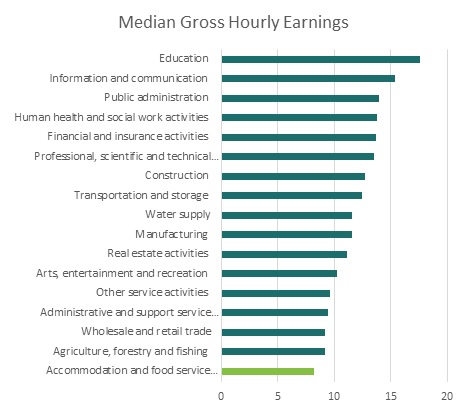
The charts below show that in 2019, before the pandemic struck, Accommodation and Food Services had both the lowest weekly and hourly earnings of any sector.
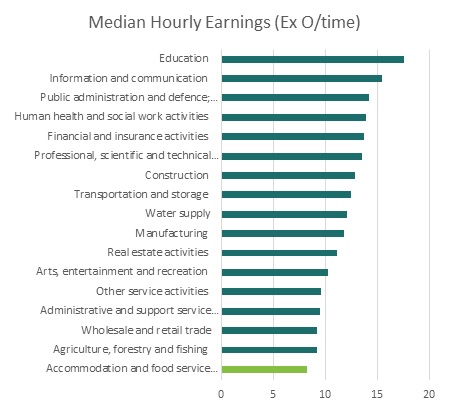
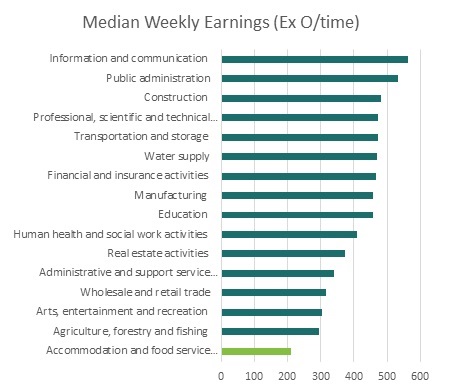
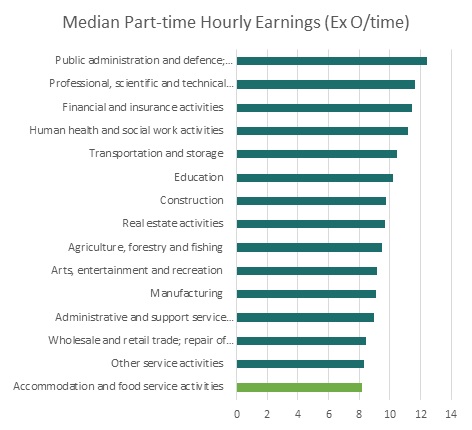
The Accommodation and Food sector is over 60% part-time employment, which means lower overall wages might be expected. However, if we look at part-time and full-time wages separately, Accommodation and Food comes out bottom again.
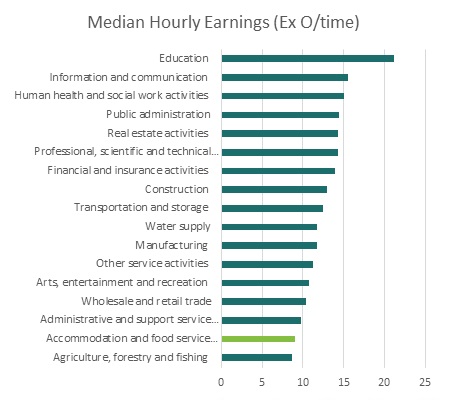
Even if we make the adjustment for gross wages, which include overtime, Accommodation and Food cannot escape the bottom of the league table.
Wages are not the only problem in the Accommodation and Food sector. Before the onset of the pandemic, the decline in high street retail led many to suggest that the growth of hospitality could provide employment for many workers made redundant by retail closures. However, research by the Resolution Foundation has shown that retail workers are no more likely to want to work in hospitality than any other workers. In fact, in many cases, they are far less likely.
As the charts above show, while retail does pay above Accommodation and Food, the difference is not huge. However, there is more to work than hourly or weekly wages. Retail jobs tend to be better jobs. Many workers cite benefits available in retail that do not exist in hospitality. Retail jobs tend to have better working conditions, better career progression and more sociable hours of work. A significant factor in this difference in job quality between retail and hospitality is the role of trade unions. While rates of unionisation are low in both sectors, almost one quarter of retail workers are covered by a collective agreement compared to just over 1 in 10 in the hospitality sector.
As we emerge from the pandemic, it is clear that the quality of work is going to be just as important as the quantity of work. Wages need to increase, but work life balance and a voice for workers are going to be just as important.