
  • X
  • Facebook
  • YouTube

Top header menu

  • Sign up to our mailing list
Home
  • Themes
      1. A New Economic Model
      2. Wages and Incomes
      3. Employment and Job Quality
      4. Climate and the Just Transition
      5. Taxes and the Welfare State
      6. Understanding the Labour Market
  • Our Work
      1. Research
      2. Blog
      3. The NERI videos series
      4. Learning about our economy
      5. Media
      6. Visualising our economy
  • Dashboards
      1. Broad sectors
      2. Subsectors
  • Events
      1. External event contributions
  • About
      1. Our team
      2. Our supporters
      3. Charities Governance Code
  • Contact

Topics

  • A New Economic Model
  • Wages and Incomes
  • Employment and Job Quality
  • Climate and the Just Transition
  • Taxes and the Welfare State
  • Understanding our Labour Market

Do Cultural Capital and Social Capital Explain the Social Origin Pay Gap?

Video
 October 
25,
 2024

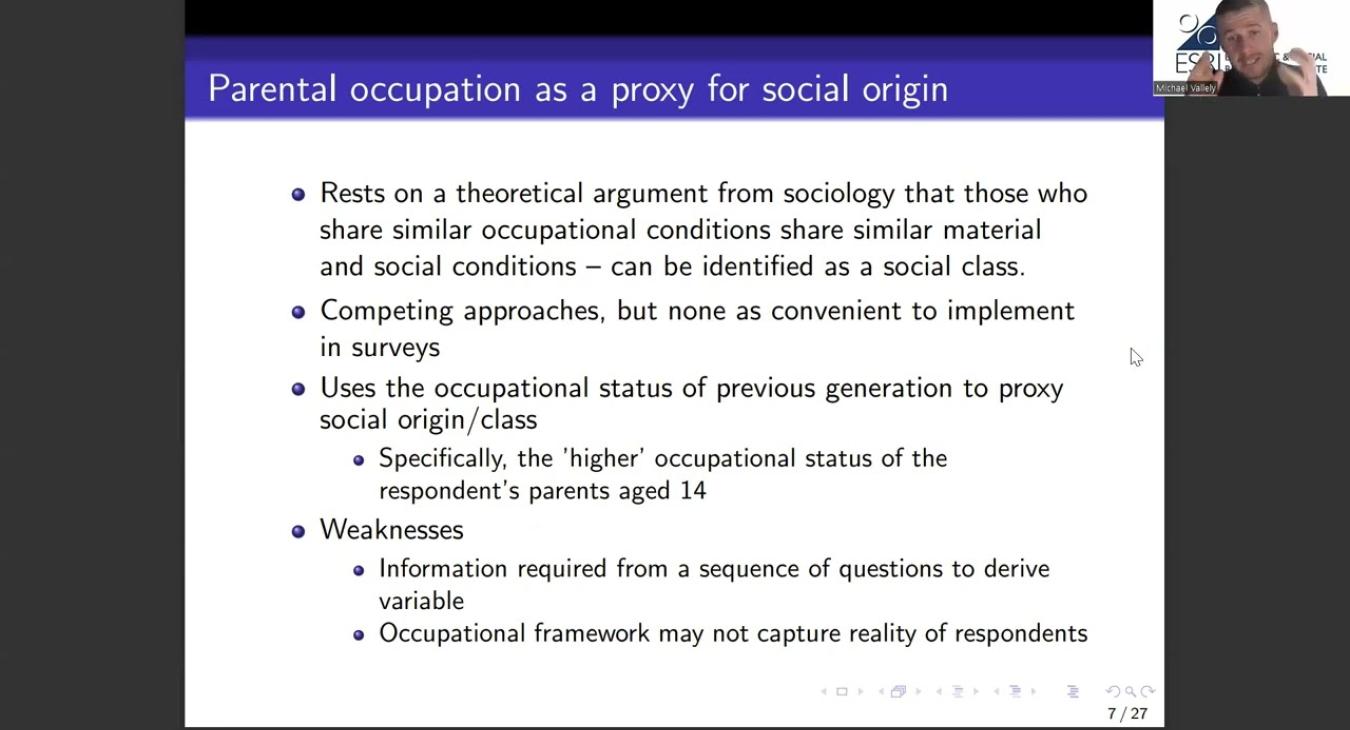
The seminar titled 'Do Cultural Capital and Social Capital Explain the Social Origin Pay Gap?' was presented by Michael Vallely, Postdoctoral Research Fellow, ESRI.  It took place on Thursday 24 October 2024.

Please find Michael's presentation.

Details of Seminar: 

Michael Vallely, ESRI made his presentation.  Subsequently, a discussion was open to the floor where the chairperson, Paul Mac Flynn, NERI Co-director presented questions to Michael.

Abstract:

A recent wave of empirical evidence has found an unexplained social origin pay gap in several high-income countries in that individuals from working class origins experience a pay penalty relative to individuals with the same levels of education from upper-class backgrounds.  Research on the 'class ceiling' has controlled for educational attainment and a range of labour market observables, highlighting that strictly human capital factors do not fully expalin the pay differences among equally qualified individuals from different social origins.  Therefore, there are other factors, beyond the narrow notion of human capital, that are class related, and can influence individuals' wages.  A wealth of qualitative literature shows that cultural capital and social capital can play a role in explaining the social origin pay gap, in terms of hiring and recruitment process, how they influence individuals' networks, their ability to establish 'fit' within managerial and professional occupations and people's chances of promotion.  However, no study has yet to quantitatively examine this.  Thus, this article examines the extent to which cultural capital and social capital explain the social origin pay gap using data from waves 1-9 (2009-2019) of Understanding Society.  We observe significant pay gaps for all social origin groups, except for those from lower managerial and professional (NS-SEC 2) origins, after controlling for the respondents' demographics, education and labour market observables.  We find that the social origin pay gap marginally increases after controlling for cultural capital but decreases when controlling for social capital.  This suggests that part of the pay gap is likely to represent the impact of unequal access to social capital.  When we consider both forms of capital, we observe the pay gaps are further reduced compared to when only controlling for social capital.  This suggests that both forms of capital complement each other and consideration of both may play a role in explaining the social origin pay gap.

Employment and Job Quality
Wages and Incomes

Upcoming events

Wed, Sep 16 2026, 3:30 - 4:30pm
The Irish labour market: Recent developments and future growth
Online Zoom event
Thu, Oct 8 2026, 3:30 - 4:30pm
The Budget 2027: NERI Post Budget Analysis
Online Zoom event
Wed, Nov 11 2026, 3:30 - 4:30pm
European Attitudes to Basic Income: exploring women's perspectives
Online Zoom event

Latest

It’s wrong to assume that job quality is the enemy of job creation
job quality
A number of business organisations recently wrote to the Economy Minister...
New Labour Market Entrants, earnings, housing costs and living standards in 2024
Man and savings
This Research InBrief by NERI economist, Ciarán Nugent examines trends in...
Progress in Pay, But Not in Participation or Progression
money
Some of the results move in the right direction, but overall the picture is one...

Breadcrumb

  1. Home
  2. Videos
  3. Do Cultural Capital and Social Capital Explain the Social Origin Pay Gap?

Subscribe to our Mailing list

  • X
  • Facebook
  • YouTube
Logo

The Nevin Economic Research Institute is a Registered Charity since the 1 August 2013 with the Charity Number - 20082130.

Privacy and Cookies

We use necessary cookies to make our site work. We also use analytics cookies without user tracking to help us improve our site.

Cookie Policy | Privacy Statement

Website design and development by Infobo.

Contact us

  •  Address: 31/32 Parnell Square, Dublin 1, Ireland
  •  Telephone: +353 1 8897722
  •  Email: [email protected]
  •  Address: 45-47 Donegall Street, Belfast BT1 2FG
  •  Telephone: +44 28 902 46214
  •  Email: [email protected]
Copyright © 2025 Nevin Economic Research Institute. All rights reserved.

Footer

  • Contact
  • Privacy
  • Cookie policy
  • Themes
    • A New Economic Model
    • Wages and Incomes
    • Employment and Job Quality
    • Climate and the Just Transition
    • Taxes and the Welfare State
    • Understanding the Labour Market
  • Our Work
    • Research
    • Blog
    • The NERI videos series
    • Learning about our economy
    • Media
    • Visualising our economy
  • Dashboards
    • Broad sectors
    • Subsectors
  • Events
    • External event contributions
  • About
    • Our team
    • Our supporters
    • Charities Governance Code
  • Contact
Clear keys input element