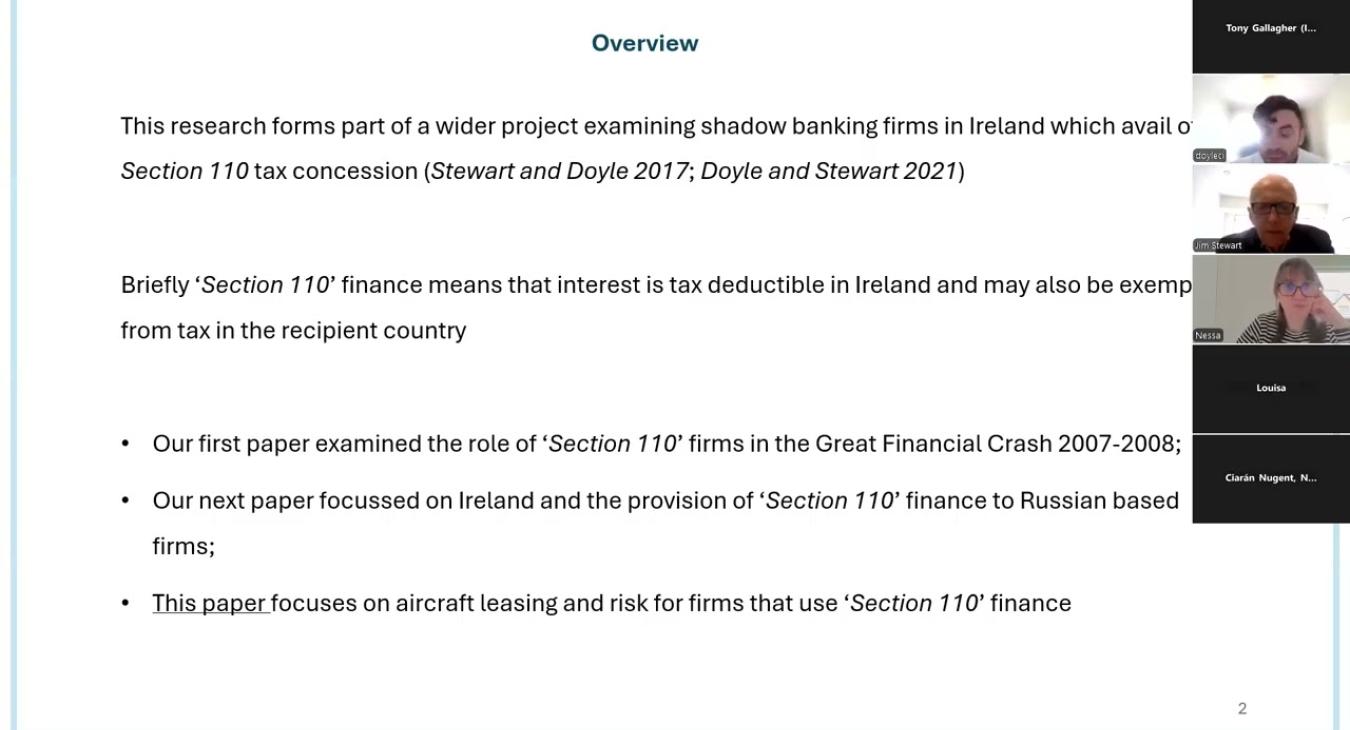
Lecture Format: Mr. Cillian Doyle, PhD student, Trinity College Dublin and Adjunct Professor in Finance, Jim Stewart, Trinity College Dubiln made their presentation. Subsequently, there was a Q&A section where the chairperson, Dr. Nessa Ní Chasaide, Maynooth University presented questions from attendees to Cillian and Jim.
Please find the presentation and the video will follow from the NERI seminar.
Abstract: Aircraft leasing is an integral part of the global aviation industry enabling new airline start-ups and expansion of existing business by reducing required capital. It gives considerable flexibility in managing changes in demand for air travel. With around 50% of the global fleet now being leased, almost all airlines lease some or all of their fleet.
Despite its size there is relatively limited data driven research on the global aircraft leasing sector. One reason for this is poor or limited data (Stewart and Doyle, 2019). This paper addresses this gap. Focusing on Ireland where around 65% of global aircraft are leased from, it is based on the accounts of leasing firms availing of Ireland’s Section 110 tax/regulatory regime.
Introduced in 1997 it gives very favourable tax treatment to interest paid on loans used in securitised financial assets (Stewart and Doyle 2017) and in corporate loans, for example to Russian based firms (Doyle and Stewart 2021). In 2011 it was extended to include aircraft leasing firms.
These loans are valuable in raising finance because interest paid is tax deductible and may also be tax free to the recipient (double non taxation). Section 110 loans are a form of hybrid financial instrument, which are a concern of the OECD’s BEPS process.
The Section 110 regime was extended in 2011 ‘to include plant and machinery, commodities and certain carbon offsets’, supposedly as part of an effort to assist the IFSC in becoming a ‘green financial services centre’. Although extending its benefits to carbon financing, aircraft leasing was the main if not the sole beneficiary.
Section 110 firms hold assets of €1.1tn (2024). Most assets relate to firms involved in securitisation, but it also includes aircraft leasing firms. The regulation and the use of Section 110 finance has been a source of controversy and adverse media attention.
The paper explores the various fiscal incentives the sector benefits from and other supporting institutional factors. Aggregate tax payments, profits, gross assets and financing of the study group are then examined. Data is then presented on local economic expenditures to assess the sector’s economic impact.
The paper argues that given the risks associated with aircraft leasing, and the relatively low contribution to the Irish economy, it is difficult to justify the extensive cost of fiscal incentives in terms of tax reliefs.
It also considers the wider impact on the future cost of leasing arising from the recent seizure of aircraft by the Russian Federation, and the future enforceability of international aviation conventions, on which the sector relies.
Biography of presenters: Cillian Doyle is a policy advisor at the Houses of the Oireachtas and a final year PhD student in the School of Business, Trinity College. His research interests include shadow banking, the IFSC, and Ireland’s tax driven approach to industrial strategy. This paper forms part of larger research project on the Section 110 tax regime. Previous research has been published in the Journal of Financial Regulation and Compliance, and Critical Perspectives in International Business.
Jim Stewart is currently an adjunct Professor in Finance in Trinity Business School, Dublin, Ireland. He was formerly an Associate professor in Finance in Trinity Business School. He has researched and published extensively in the area of finance. His current research interests include corporate taxation and MNE tax strategies, measuring effective tax rates, offshore financial centres and shadow banking.
He has a Ph.D from the London School of Economics, an M.sc from the University of Stirling in Scotland and undergraduate degrees from Trinity College, Dublin.