

Despite its prominence in various public policy discussions over recent years, detailed information on wealth in Ireland has been sparse. For the most part discussion on the distribution of wealth, and concepts such as a wealth tax, were based on hunches and guestimates or assumptions that the wealth distribution must have in some way resembled the income distribution (at least as unequal and probably worse).
Finally, that has changed with the publication in late January of the results of a new survey from the Central Statistics Office (CSO) - The Household Finance and Consumption Survey. The HFCS is part of a European initiative to improve countries knowledge of the socio-economic and financial situations of households across the EU. For the first time, its results offer robust information on the types and levels of wealth that households in Ireland possess. The data was collected for 2013.
Overall, the level of household net wealth in Ireland amounts to €378 billion. The CSO’s net wealth measure includes the value of all assets (housing, land, investments, valuables, savings and private pensions) and removes any borrowings (mortgages, loans, credit card debt etc) to give the most informative picture of households wealth. On average the results imply that Irish households have a net wealth of almost €225,000 each. However, averages are very misleading for wealth data, as they are skewed upwards by high wealth households. Looking closer at the data, the CSO show that the bottom 50% of households have a net wealth of less than €105,000.
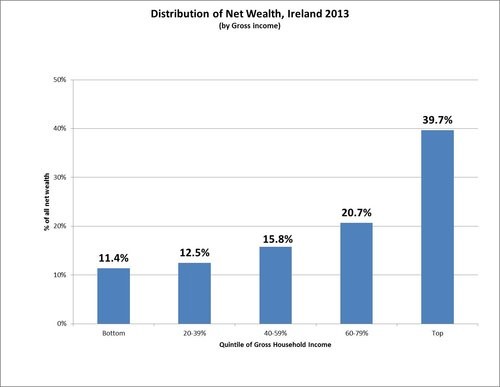
While there is much analytical work yet to be undertaken on this new data, the initial results offer some details on the distribution of wealth across society. Firstly, there is some wealth present across most of the population – 95% of households have some ‘real assets’ such as houses, land, business wealth, vehicles and valuables and 90% have some ‘financial assets’ such as savings, investments and private pensions. Of course, the scale of wealth that households possess in these assets differs. Comparing net wealth across the income distribution, the HFCS results show that those in the top 20% of the income distribution possess 39.7% of all the wealth – this is the same share as those in the bottom 60% of the income distribution (see chart).
Net wealth also has an unsurprising relationship with age – it is lowest for younger households and increases to a peak between the ages of 55-64 before declining in retirement. Across the various household types that the CSO examined, those with the lowest wealth were single parents, the unemployed and those under 35 years.
The data also offers an insight into the composition of household’s wealth across Ireland. 36% of households own their home outright (no mortgage) and 34% own their home with a mortgage. 11% of households own land, many of these are farmers where the land carries a high value although for the most part the income return from this land is relatively low. More than 88% have some savings and 82% possess a vehicle. 61% of households have some valuables and 20% have wealth in the form of a business which they own and work in. Unfortunately, the new data is less than comprehensive on pension wealth – capturing only those with private voluntary pensions (10% of households) and do not record those with entitlements to pensions which will flow from a collective pension pool or other source which is not explicitly owned by any member of the household. As such the data miss the value of pension wealth for those with defined benefit entitlements and the pension entitlements of most of those working in the public sector.
Knowing all of this, about the levels and composition of wealth in Ireland, brings new light to the recurring discussion around the broadening of the tax base and the potential for a wealth tax - a topic that is bound to reappear in various debates and discussions this side of Election 2016.
Using the indicative data contained in the CSO report (there are more detailed data to come in the months ahead), it is possible to consider the shape of a potential net wealth tax and the quantum of revenue it could raise. A wealth tax which excluded people’s homes, farm land, people’s vehicles and people’s pension savings would exclude between €260 billion and €300 billion of the overall net wealth of households. The remaining €78 billion would be the tax base and were wealth taxed at a rate of 0.5% it could raise approximately €400 million per annum for the exchequer. Such a tax would fall on wealth in the form of investments in property, shares and bonds alongside business assets and savings. Further exclusions of assets, or the (realistic) introduction of wealth thresholds below which a liability would not arise, would reduce this potential revenue further. Overall, it is hard to imagine an annual recurring revenue flow from a 0.5% wealth tax of more than €200 million – a not insignificant amount of money, but not the silver bullet that would close the gap between current levels of taxation revenue and those required to sustainably fund the demographic demands and public service improvements needed in the years ahead.
It is clear from the new wealth data, that most household wealth in Ireland comprises family homes, farm land, the ownership of businesses, investment property and to a lesser degree valuables (jewellery, antiques and paintings) and savings. In terms of any reforms to current taxation policy, there seems to be merit in revisiting the structures of inheritance taxes (Capital Acquisitions Taxes) and in particular the generous thresholds and exemptions that facilitate tax-free intergenerational transfer of large amounts of wealth. A reformed CAT combined with a property tax, an appropriate taxation of capital gains and a progressive income tax system are necessary ingredients in any further broadening of the tax base.
As the new CSO data shows, there is a lot of wealth and wealth inequality in Ireland. Now that we finally (after many years of waiting) know how much of each there is, the time is right for a more informed policy discussion on how we think about wealth, its accumulation and its transfer in Irish society. Without solid data that was not possible up to now – things have changed.
Dr Micheál Collins is Senior Research Officer at the Nevin Economic Research Institute (NERI). The new CSO wealth data is available here
A version of this blog appears as an article in the February 2015 edition of Village Magazine
An article from the Q1 2015 Central Bank Quarterly Bulletin also looked at this data and is available here